


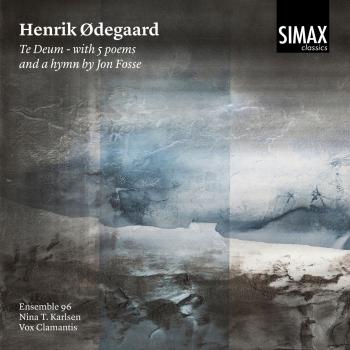
Ensemble 96 & Vox Clamantis
Biography Ensemble 96 & Vox Clamantis
Ensemble 96
The chamber choir Ensemble 96 consist of 24 highly qualified singers, is one of Norway’s leading vocal ensembles, and has gained its reputation through many critically acclaimed concerts, premieres and CD recordings.
Ensemble 96 has a particular focus on contemporary music and seeks to expand the traditional choir concert by means of collaborations with other artists, including dancers, actors and visual artists. The ensemble often presents a mix of contemporary music and classical songs.The musical director and conductor is Nina Therese Karlsen, who holds an MA in Choir Conducting from the Norwegian Academy of Music.
Ensemble 96’s CD Immortal Nystedt, on the label 2L, was nominated for two Grammy awards in 2007, Best Surround Sound Album and Best Choral Performance. In September 2007 Ensemble 96 and its previous conductor Øystein Fevang received the Choral Award in Norway. The choir, with conductor Kjetil Almenning, represented Norway at the Nordic-Baltic Choral Festival in August 2008. The choir received a second Grammy nomination in 2011 for their CD Kind. It receives financial support from Arts Council Norway.
Ensemble 96 has made first performances of works by, amongst others, Knut Nystedt, Synne Skouen, Antonio Bibalo, Wolfgang Plagge, Jon Balke, Andrew Smith, Kjell Mørk Karlsen, Kjetil Bjørnstad, Trond Lindheim, Olav Anton Thommesen, Julian Skar, Marcus Paus, Frank Havrøy, Martin Ødegaard and Tyler Futrell.
Vox Clamantis
is a vocal ensemble that revolves around its leader Jaan-Eik Tulve. During the twenty-two years of its existence singers have come and gone, but one man and his vision of music have always been consistently in the centre.
It all started with Gregorian chant, which Tulve studied in Paris in the 1990s. Back in Estonia he formed Vox Clamantis in 1996 to continue singing this ancient plainchant which is the foundation of Western art music. The ensemble’s various line- ups were always like gatherings of kindred spirits, devotees of the idea that the essence of Gregorian chant can reach beyond its stylistic boundaries and blend freely with the music of modern times and other cultures.
The ensemble has performed with the electric guitars of Weekend Guitar Trio and the oud of yair Dalal, the voice of Dhafer youssef from Tunisia, the nyckelharpa of Marco Ambrosini and the pure voice of Arianna Savall.
Vox Clamantis has often performed music by Estonian composers as well, including the energetic compositions of Erkki-Sven Tüür, the electronic explorations of Sven Grünberg and Helena Tulve’s delicate sound-webs. This list is not exhaustive, and the ensemble is always open to new collaborations.
The members of the ensemble devote their skills and energy to Vox Clamantis while also pursuing other occupations. Some of them are professional singers or instrumentalists, some are composers or conductors, while others work outside the field of music. Singing in Vox Clamantis has been a learning process full of discoveries for all involved. The sincere dedication to the music making of the early years has gradually been channelled into a confident and eloquent individual voice that is now internationally recognised.
In 2012 ECM released the album ‘Filia Sion’, which earned positive reviews. In the same year the ensemble participated in the Grammy-winning album ‘Adam’s Lament’ with music by Arvo Pärt. In 2013 the recording of Liszt’s Via crucis for Mirare with French pianist Jean-Claude Pennetier won a Diapason d’or award, and the singing of Vox Clamantis was also heard in Paolo Sorrentino’s film La grande bellezza (The Great Beauty), which won an Academy Award (oscar) in 2014. The group’s most recent CD, ‘Arvo Pärt: The Deer’s Cry’ (ECM), won a Diapason d’or, a Choc de Classica, a nomination for the BBC Music Magazine Award and the Album of the year award in Estonia.
The connection between Vox Clamantis and Arvo Pärt dates back to 1999, when the ensemble started to perform his organ piece Annum per Annum combined with liturgical chant, and the composer was enthusiastic about their idea. Since then, the group’s contact with Pärt’s music has deepened. Today it is a relationship that is warm and friendly rather than just professional.
Henrik Ødegaard
was born in Oslo 28.07.1955. After studying the bass trombone and church music he studied composition with Lasse Thoresen at the Norwegian State Academy of Music and with Tristan Keuris at the Utrecht Conservatorium in Holland as well as studies in the ”Gregorian chant class” at the National Conservatory in Paris with Louis-Marie Vigne as main teacher.
A substantial propotion of Ødegaard´s works are composed for the church. Residing in Telemark puts Ødegaard in the centre of a vital folk-music scene – a musical heritage that has proved to play an increasing part of the composers approximation process towards folk music. Ødegaard has devoted much work focusing on the hardanger fiddle.