

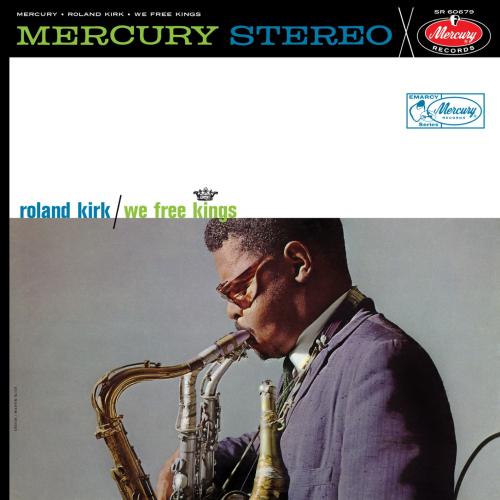
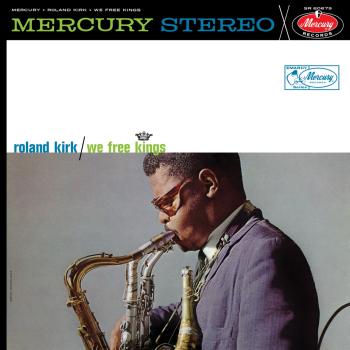
We Free Kings (2025 Remaster) Rahsaan Roland Kirk
Album Info
Album Veröffentlichung:
2026
HRA-Veröffentlichung:
30.01.2026
Das Album enthält Albumcover
Entschuldigen Sie bitte!
Sehr geehrter HIGHRESAUDIO Besucher,
leider kann das Album zurzeit aufgrund von Länder- und Lizenzbeschränkungen nicht gekauft werden oder uns liegt der offizielle Veröffentlichungstermin für Ihr Land noch nicht vor. Wir aktualisieren unsere Veröffentlichungstermine ein- bis zweimal die Woche. Bitte schauen Sie ab und zu mal wieder rein.
Wir empfehlen Ihnen das Album auf Ihre Merkliste zu setzen.
Wir bedanken uns für Ihr Verständnis und Ihre Geduld.
Ihr, HIGHRESAUDIO
- 1 Three For the Festival 03:07
- 2 Moon Song 04:20
- 3 A Sack Full Of Soul 04:37
- 4 The Haunted Melody 03:37
- 5 Blues For Alice 04:06
- 6 We Free Kings 04:44
- 7 You Did It, You Did It 02:27
- 8 Some Kind Of Love 06:09
- 9 My Delight 04:28
Info zu We Free Kings (2025 Remaster)
Known as a then-young Kirk’s more consistent works, 1962’s "We Free Kings" is a solid balance of bop with complimenting soul, backed by two different rhythm sections - one including Hank Jones (piano) & Wendell Marshall (bass) and the other with Richard Wyands (Piano) & Art Davis (Bass) while Charlie Persip (Drums) maintains throughout. The repertoire is primarily a showcase of Kirk’s skill is a composer, though his take on Bird’s "Blues For Alice" is not to be missed.
The title track of We Free Kings is a Kirk composition, where the multi-instrumentalist (including tenor saxophone, manzello, flute, and stritch saxophone) put his spin on the classic Christmas carol “We Three Kings.” The album is a mix of originals that showcase Kirk’s sharp arranging and writing skills, as well as additional covers of jazz standards like 1932’s “Moon Song (That Wasn’t Meant for Me)” (arranged by Arthur Johnston and written by Sam Coslow) and 1951’s “Blues for Alice” (composed by Charlie Parker).
Roland Kirk, tenor saxophone, manzello, flute, stritch saxophone
Richard Wyands, piano (tracks 3–5 & 9)
Art Davis, double bass (tracks 3–5 & 9)
Charlie Persip, drums
Hank Jones, piano (tracks 1–2 & 6–8)
Wendell Marshall, bass (tracks 1–2 & 6–8)
Digitally remastered
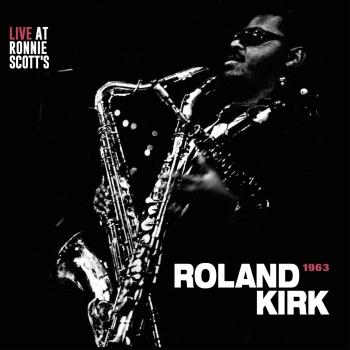
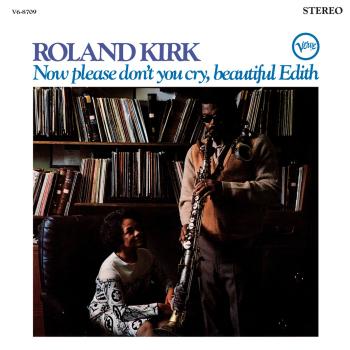
Rahsaan Roland Kirk
(multi-instrumentalist) was born in Columbus, Ohio on Aug. 7, 1935 and passed away on Dec. 5, 1977 in Bloomington, Indiana.
Kirk was born Ronald Theodore Kirk, but felt compelled by a dream to transpose two letters in his first name to make Roland. He became blind at the age of two, as a result of poor medical treatment. In 1970, Kirk added “Rahsaan” to his name after hearing it in a dream.
He started playing the bugle and trumpet, then learned the clarinet and C-melody sax. Kirk began playing tenor sax professionally in R&B bands at the age of 15. While a teenager, he discovered the “Manzello” and “Stritch” — the former, a modified version of the Saxello, which was itself a slightly curved variant of the B flat soprano sax; the latter, a modified straight E flat alto. To these and other instruments, Kirk began making his own improvements. He reshaped all three of his saxes so that they could be played simultaneously; he’d play tenor with his left hand, finger the Manzello with his right, and sound a drone on the Stritch, for instance. Kirk’s self-invented technique was in evidence from his first recording, a 1956 R&B record called Triple Threat. By 1960 he had begun to incorporate a siren whistle into his solos, and by ’63 he had mastered circular breathing, a technique that enabled him to play without pause for breath.
In his early 20s, Kirk worked in Louisville before moving to Chicago in 1960. That year he made his second album, Introducing Roland Kirk, which featured saxophonist/trumpeter Ira Sullivan. In 1961, Kirk toured Germany and spent three months with Charles Mingus. From that point onward, Kirk mostly led his own group, the Vibration Society, recording prolifically with a range of sidemen.
Preferring to lead his own bands, Kirk rarely performed as a sideman, although he did record with arranger Quincy Jones and drummer Roy Haynes and had notable stints with bassist Charles Mingus. One of his best-known recorded performances is the lead flute and solo on Jones’ “Soul Bossa Nova”, a 1964 hit song re-popularized in the Austin Powers films (Jones 1964; McLeod et al. 1997). In the early ’70s, Kirk became something of an activist; he led the “Jazz and People’s Movement,” a group devoted to opening up new opportunities for jazz musicians.
His playing was generally rooted in soul jazz or hard bop, but Kirk’s knowledge of jazz history allowed him to draw on many elements of the music’s past, from ragtime to swing and free jazz. Kirk also absorbed classical influences, and his artistry reflected elements of pop music by composers such as Smokey Robinson and Burt Bacharach, as well as Duke Ellington, John Coltrane and other jazz musicians.
The live album Bright Moments (1973) is an example of one of his shows. His main instrument was the tenor saxophone, supplemented by other saxes, and contrasted with the lighter sound of the flute. At times he would play a number of these horns at once, harmonizing with himself, or sustain a note for lengthy durations by using circular breathing, or play the rare, seldom heard nose flute. A number of his instruments were exotic or homemade, but even while playing two or three saxophones at once, the music was intricate, powerful jazz with a strong feel for the blues.
Kirk was politically outspoken. During his concerts, between songs he often talked about topical issues, including black history and the civil rights movement. His monologues were often laced with satire and absurdist humor. According to white comedian Jay Leno, when Leno toured with Kirk as Kirk’s opening act, Kirk would introduce him by saying, “I want to introduce a young brother who knows the black experience and knows all about the white devils …. Please welcome Jay Leno!”
In 1975, Kirk suffered a major stroke which led to partial paralysis of one side of his body. However, he continued to perform and record, modifying his instruments to enable him to play with one arm. At a live performance at Ronnie Scott’s club in London he even managed to play two instruments, and carried on to tour internationally and even appear on television.
He died from a second stroke in 1977 after performing in the Frangipani Room of the Indiana University Student Union in Bloomington, Indiana.
Dieses Album enthält kein Booklet