



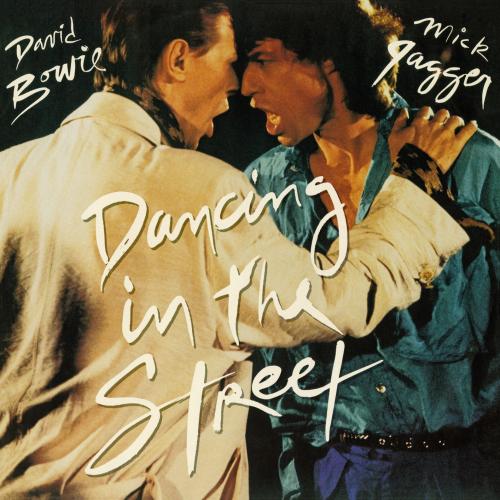
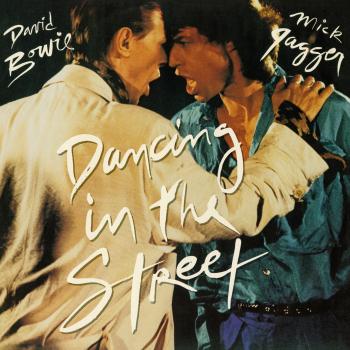
Dancing In The Street E.P. (2025 Remaster) David Bowie & Mick Jagger
Album info
Album-Release:
1985
HRA-Release:
29.08.2025
Album including Album cover
I`m sorry!
Dear HIGHRESAUDIO Visitor,
due to territorial constraints and also different releases dates in each country you currently can`t purchase this album. We are updating our release dates twice a week. So, please feel free to check from time-to-time, if the album is available for your country.
We suggest, that you bookmark the album and use our Short List function.
Thank you for your understanding and patience.
Yours sincerely, HIGHRESAUDIO
- 1 Dancing In The Street (Clearmountain Mix) [2025 Remaster] (Clearmountain Mix, 2025 Remaster) 03:11
- 2 Dancing In The Street (Instrumental) [2025 Remaster] (Instrumental, 2025 Remaster) 03:21
- 3 Dancing in the Street (Steve Thompson Mix) [2025 Remaster] (Steve Thompson Mix, 2025 Remaster) 04:40
- 4 Dancing in the Street (Edit) [2025 Remaster] (Edit, 2025 Remaster) 03:23
- 5 Dancing in the Street (Dub) [2025 Remaster] (Dub, 2025 Remaster) 04:41
Info for Dancing In The Street E.P. (2025 Remaster)
40 years ago today, Live Aid, the benefit concert organised by Bob Geldof and Midge Ure to raise further funds for relief of the famine in Ethiopia, was announced with a press conference on the pitch at Wembley Stadium. The show was held simultaneously on Saturday, 13th July 1985, at Wembley and John F. Kennedy Stadium in Philadelphia. One of the day's highlights was the surprise duet of the Motown classic, 'Dancing In The Street', between David Bowie and Mick Jagger.
"We had such a laugh doing Dancing in the Street with both the song recorded in the studio and the video done in one day. Remarkable how we pulled it off really. The video is hilarious to watch now. We enjoyed camping it up and trying to impersonate each other’s moves, making it up as we went along. It was the only time David and myself collaborated on anything, which is a real shame.” (Mick Jagger, June 2025)
The original plan for Live Aid was to perform the track together live, with Bowie at Wembley Stadium and Jagger at John F. Kennedy Stadium in Philadelphia. It soon became apparent that the satellite link-up between the two countries would mean a half-second delay, rendering the plan impossible. Instead, the pair convened at Westside Studios in London on 29th June, where Bowie was working with producers Clive Langer & Alan Winstanley. The duo went directly from the studio to Spillers Millennium Mills in the East End to shoot the video with director David Mallet, who had previously worked with Bowie on the groundbreaking Ashes To Ashes video. The video has been upgraded to high resolution to celebrate the anniversary using the original film negative.
Speaking about the song and video at the time, Bowie said “We thought about it on a Thursday night and we just went through a bunch of old songs and thought that ‘Dancing’ was one we both knew very well and then we went into the studio between 7 and 11 on Saturday night and then we went over to the Docklands and shot the video for the rest of the night so we did the whole thing in ten hours, it was great.” He also talked about the spirit of Live Aid, saying, “Everybody out there who sent money in, you’re the real heroes because it’s easy for me to go up there and sing some songs, but it’s much harder for you to give money and not be recognised. Good on ya!”
David Bowie & Mick Jagger
Digitally remastered
Please Note: We offer this album in its native sampling rate of 48 kHz, 24-bit. The provided 96 kHz version was up-sampled and offers no audible value!
David Bowie
(1947-2016) revolutionised popular music and culture through five decades of fearless experimentation and reinvention.
Between the late 1960s and mid-1970s, Bowie pioneered multi-media performance art while recording groundbreaking albums including Space Oddity (1969), The Man Who Sold The World (1970), The Rise and Fall of Ziggy Stardust and the Spiders from Mars (1972), Aladdin Sane (1973), Diamond Dogs (1974), Young Americans (1975), and Station to Station (1976). His single "Fame" from Young Americans became his first US No. 1 hit.
In 1976, Bowie relocated to Berlin, where he collaborated with Brian Eno and Tony Visconti on the influential "Berlin Trilogy": Low (1977), “Heroes" (1977), and Lodger (1979). In 1979 and 1980, he made his Broadway debut in The Elephant Man and released Scary Monsters (and Super Creeps) with Visconti, followed by the Nile Rodgers-produced Let's Dance (1983).
Throughout the mid-1980s and early 1990s, Bowie formed the band Tin Machine, collaborated with dance company La La La Human Steps, and composed music for Hanif Kureishi's The Buddha of Suburbia (1993). In 1992, he created Jump, one of rock's first CD-ROMs (Enhanced CD). Reuniting with Eno in 1995, he produced the experimental Outside, followed by Earthling (1997) and 'hours...' (1999). That same year, he was honoured as Commandeur dans l'Ordre des Arts et des Lettres.
In 2002, Bowie collaborated again with Tony Visconti on Heathen, performing the album in full alongside the seminal Low during European and American tours. Reality followed in 2003, launched with the world's largest interactive live-by-satellite event, followed by the critically acclaimed "A Reality Tour."
Bowie's film credits include iconic roles in Nic Roeg's The Man Who Fell to Earth (1976), Nagisa Oshima's Merry Christmas Mr. Lawrence (1983), Martin Scorsese's The Last Temptation of Christ (1988), Tony Scott's The Hunger(1983), and Christopher Nolan's The Prestige (2006).
In May 2007, he curated the inaugural 10-day High Line Festival in New York. The following month, he received the Webby Lifetime Achievement Award for pioneering the intersection of art and technology. Later that year, he starred as himself in an acclaimed episode of Ricky Gervais's HBO series Extras.
In 2012, a plaque was erected on Heddon Street, London, the site of the Ziggy Stardust album cover, commemorating his extraordinary influence. That same year following year, the Victoria and Albert Museum received unprecedented access to the David Bowie Archive for a groundbreaking exhibition that broke attendance records in London, the US, Berlin, and Paris.
On January 8, 2013, Bowie surprised the world by releasing "Where Are We Now?" and announcing The Next Day, his 30th studio album and first in 10 years. The album received universal critical acclaim. In 2014, the compilation Nothing Has Changed celebrated his 50th year in music, followed by the experimental "Sue (Or in a Season of Crime)" with the Maria Schneider Orchestra and "Tis a Pity She Was a Whore."
Spring 2015 brought Lazarus, an off-Broadway production co-created with playwright Enda Walsh and directed by Ivo van Hove, which later transferred to London's Kings Cross Theatre.
★(Blackstar), Bowie's 28th studio album, was released on his 69th birthday, January 8, 2016. Co-produced with Visconti and featuring saxophonist Donny McCaslin and his quartet, ★ received overwhelming critical acclaim, among the best reviews of Bowie's entire career. It became his first album to reach No. 1 in the US, topped charts in over 20 countries, and later won five Grammy Awards.
On January 10, 2016, David Bowie died peacefully, surrounded by his family, after an 18-month battle with cancer. His body of work, multi-generational influence, and legacy of fearless innovation and endless reinvention continue to inspire artists and audiences worldwide.
This album contains no booklet.