

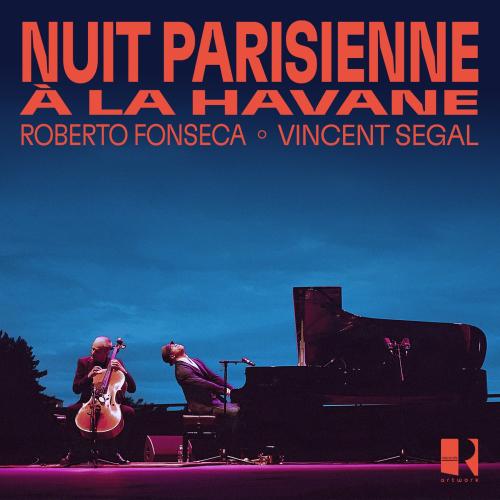
Nuit parisienne à La Havane Vincent Segal & Roberto Fonseca
Album Info
Album Veröffentlichung:
2026
HRA-Veröffentlichung:
30.01.2026
Label: Artwork Records
Genre: Jazz
Subgenre: Contemporary Jazz
Interpret: Vincent Segal & Roberto Fonseca
Das Album enthält Albumcover
- 1 Rumbo a Tí 02:38
- 2 Soul Kiss 04:10
- 3 Nuit Parisienne 04:36
- 4 Paciencia Es Lo Que Hay Que Tener 02:59
- 5 Un Homme Qui Dort 05:03
- 6 Day 04:30
- 7 Violoncelle Pointe Noire 00:51
- 8 Free 02:58
- 9 La Mar Quieta, Tú, Yo Pensando 04:59
- 10 Interlude Piano Silence Sound 00:55
- 11 Te Extraño (M.C.A) 06:11
Info zu Nuit parisienne à La Havane
Roberto Fonseca und Vincent Segal nahmen Nuit Parisienne à La Havane innerhalb von fünf Tagen auf. Ein spontanes Zusammentreffen, das keinerlei Vorbereitung erforderte. Sie setzten sich einfach hin und begannen zu spielen – so entstand dieses Album.
Was also geschieht, wenn Paris und Havanna aufeinandertreffen? Die beiden Künstler tauchen tief in die kubanische Tradition ein und spielen zugleich mit klassischen Formen. Dabei rufen sie eine Epoche in Erinnerung, die Roberto nur allzu gut kennt – die des frühen 20. Jahrhunderts, als sich spanische klassische Musik und kubanische Rhythmen vermischten und das entstehen ließen, was später Danzón und Danzonete genannt wurde. Fonseca und Segal fügen dem eine Prise Improvisation hinzu – und damit Moderne.
Man sucht diese Musik nicht, und man hört sie auch nicht, um sie zu analysieren – sie kommt zu einem. Ihre Subtilität überrascht, weil sie in Bildern spricht. Das melodische Wechselspiel kitzelt die Wahrnehmung, zieht einen in die Außenwelt und umhüllt einen, während es zugleich im Inneren weiterlebt. Es ist eine Welt aus Echos und Erinnerungen, ein Wirbel aus Ideen und Gefühlen, die sich ständig erneuern und immer neue Bedeutungen finden.
In einer Zeit, in der künstliche Intelligenz allgegenwärtig scheint – sowohl in der Musikindustrie als auch in unserem Alltag –, erinnert uns diese Musik daran, dass das Geheimnis nicht darin liegt, zu kontrollieren, hinzuzufügen oder die Schöpfung für sich zu beanspruchen, sondern vielmehr darin, zu dekonstruieren, wegzulassen und Raum für Klarheit zu schaffen. Das Geheimnis besteht darin, den kreativen Prozess zu seinem Wesenskern zurückzuführen – Nuit Parisienne à La Havane tut genau das. Es ist ein Album, das nicht um unsere Aufmerksamkeit bittet, keine Rezensionen erwartet und keine Analyse einfordert. Es will gefühlt werden – vielleicht sogar betrachtet – wie eine Abfolge von elf Kurzfilmen, die sich vor unseren Augen entfalten. Es liegt an uns, die Bilder in unserem Geist schweben zu lassen, sie aufzunehmen und schließlich wieder verschwinden zu lassen.
Diese fünftägige Improvisationssession führt uns durch höchst unterschiedliche Genres: von kubanischen Rhythmen verschiedener Epochen über französisches Chanson, klassische Musik, afrikanische Rhythmen bis hin zu östlichen Einflüssen. Sie stellt die Frage: Was wäre, wenn auch die Musik mit den großen Herausforderungen der modernen Welt konfrontiert würde?
Roberso Foncesca,Klavier
Vincent Segal, Cello
Vincent Segal & Roberto Fonseca
When Ballake Sissoko and Vincent Segal released their first collaborative album, Chamber Music, they caught the music world by surprise. Everything about this duo was unexpected: the Malian master of the traditional harp, or kora; the French cellist with the unlikely background in trip-hop; and the elegant, soulful music they made together. The album appeared on numerous best-of lists in both Europe (in 2009) and North America (in 2011). Now, these two sonic voyagers have returned with Musique de Nuit (“Night Music”) – an album which may not have the same element of surprise, but which may be even more spellbinding than its predecessor.
After years of touring together Sissoko and Segal have created their own hybrid tradition, one that draws on the ancient well of West African troubadour songs, the rich heritage of Baroque music, and an elusive but somehow clearly modern sensibility. Musique de Nuit refines their approach: where Chamber Music included several guests, most of this album consists solely of duets – though your ears may tell you different.
Much of this is due to Segal’s inventive cello playing, which can provide a percussive groove in the lilting opener “Niandou” or imitate the njarka, the Malian fiddle, in “Balazando.” The seamless way that he moves from one sound to another gives the illusion of several musicians playing at once. Sissoko, meanwhile, weaves a filigreed texture of sound from his kora, which is both a melodic and a rhythmic instrument. And while you’d never mistake this for a jazz album, it does share a spiritual kinship with the great album of duets made by Duke Ellington with bassist Jimmy Blanton, in the sense that it captures two musicians keenly listening to each other, and responding with an almost telepathic connection to each change of timbre or rhythm.
“It’s actually a bit husky, and raw,” Vincent Segal explains. “There are out-of-tune notes and fingernails crack sometimes, but there’s a sort of activity between us in those moments that I love.” The idea, he says, was not to try to re-create the sounds of a performance in a beautiful concert hall, but something much more personal and intimate; “I love listening to my musician friends at their places, in the studio between sessions, in the backstage area.”
Perhaps the most magical thing about Musique de Nuit is that after years of touring, and performing together on hundreds of stages around the world, the album has the feeling of eavesdropping on a late-night jam session. In fact, the album was recorded in two sessions in the Malian capitol of Bamako – one at night on Ballake’s rooftop, and the other during the day in the famed Bogolan studio. “We’ve always had this connection to the oral tradition,” Segal says, “and improvisation, and clarity of discourse.” Those deep roots give the album a timeless cast, as it moves between quietly beautiful nocturnes and lively, dance-based melodies.
Dieses Album enthält kein Booklet