





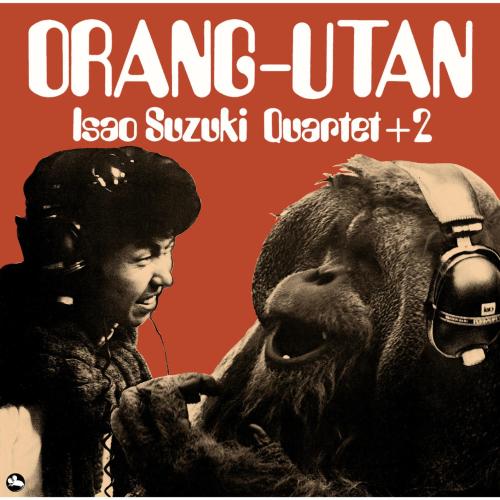
ORANG-UTAN (Remastered) Isao Suzuki Quartet +2
Album Info
Album Veröffentlichung:
1975
HRA-Veröffentlichung:
21.10.2026
Label: Sony Music Labels Inc.
Genre: Jazz
Subgenre: Contemporary Jazz
Interpret: Isao Suzuki Quartet +2
Das Album enthält Albumcover
Entschuldigen Sie bitte!
Sehr geehrter HIGHRESAUDIO Besucher,
leider kann das Album zurzeit aufgrund von Länder- und Lizenzbeschränkungen nicht gekauft werden oder uns liegt der offizielle Veröffentlichungstermin für Ihr Land noch nicht vor. Wir aktualisieren unsere Veröffentlichungstermine ein- bis zweimal die Woche. Bitte schauen Sie ab und zu mal wieder rein.
Wir empfehlen Ihnen das Album auf Ihre Merkliste zu setzen.
Wir bedanken uns für Ihr Verständnis und Ihre Geduld.
Ihr, HIGHRESAUDIO
- 1 Blue Road 11:20
- 2 L. A. Breakdown 07:30
- 3 My One And Only Love 06:51
- 4 Orang-Utan 15:03
Info zu ORANG-UTAN (Remastered)
Sony Japan is pleased to present Isao Suzuki's fourth album off the Three Blind Mice label, "Orangutan". The 1975 free jazz album features acclaimed saxophonist Mori Kenji and guitarist Kazumi Watanabe, and remains undiminished by the years.
Despite being a well-regarded and sought-after slice of Japanese jazz-funk and contemporary jazz perfection, Orang-Utan has never previously been released outside of Japan. Given that original copies of the album regularly fetch three-figure sums online, this global reissue is arguably well overdue. Recorded by Japanese scene stalwarts Isao Suzuki Quartet (with the addition of two guest musicians) in April 1975, the set is topped and tailed by two long, up-tempo workouts, of which fizzing, funk-fuelled opener "Blue Road" stands out (though hardcore jazz-heads may prefer the title track). In between, you'll find two relaxed, laidback affairs where Japanese jazz-rock legend Kazume Watanabe's languid solos come to the fore.
Bassist Isao Suzuki's popularity shot up to stratosphere with the release of Blow Up from the Three Blind Mice label. By the time he recorded this, fourth album for the label, he was actually the winner of the Swing Journal Readers' Poll. And this rather strangely titled album doesn't disappoint.
Suzuki had a knack for surrounding himself with superb musicians and playing brilliant, groovy music that is firmly rooted in the jazz tradition. This time, he picked as the all-important horn player Kenji Mori whose superb playing on alto sax, bass clarinet and flute strongly remind us of Eric Dolphy. The guitar genius Kazumi Watanabe turns in wonderfully nuanced performances in every setting. Also, not insignificantly, Mari Nakamoto--one of the best female jazz vocalists Japan has ever produced--appears as a guest and sings Shirley Horn's "Where Are You Going?" with excellent results.
Isao Suzuki, bass, cello, electric piano
Kenji Mori, alto saxophone, bass clarinet, flute
Kazumi Watanabe, guitar
Osamu Kawakami, bass
Shinji Mori, drums
Mari Nakamoto, vocals
Recorded on April 4, 1975 in Tokyo
Digitally remastered by Bernie Grundman
Isao Suzuki
was born on January 2, 1933, in Tokyo. He attended a Louis Armstrong All Stars concert in December 1953, an experience that shaped his decision to pursue jazz. In 1956, Suzuki began his professional career playing double bass on United States military bases in Tokyo. He developed foundational skills in bebop while performing with prominent Japanese musicians including Sadao Watanabe, Hidehiko Matsumoto, and Shotaro Moriyasu. From 1965 to 1969, Suzuki led his own ensemble and consolidated his position as a bandleader within Tokyo’s developing jazz scene. Suzuki moved to New York City in 1969 and spent two transformative years immersed in the jazz circuit. He recorded and performed as a sideman with Charles Mingus, Thelonious Monk, Ella Fitzgerald, Ron Carter, Jim Hall, and Paul Desmond. Suzuki also spent approximately one year with Art Blakey’s Jazz Messengers, an experience he credited as formative to his understanding of jazz discipline. He returned to Japan in 1971 after Art Blakey’s arrest at a Canadian airport ended the engagement. Upon returning to Japan, Suzuki became a catalyzing force in Japanese jazz and signed with Three Blind Mice Records. His breakthrough album “Blow Up” (1973) featured drummer George Otsuka, pianist Kunihiko Sugano, and bassist Takashi Mizuhashi. The album won the Jazz of Japan Award and Swing Journal’s Jazz Disc Award. Suzuki showcased distinctive mastery of both double bass and cello, employing pizzicato lines and unconventional techniques including scratched cello and found percussion on tracks such as “Aqua Marine.” This established Three Blind Mice’s audiophile engineering standard and became a cornerstone of Japanese modern jazz. During the 1970s, he led a prolific recording career across multiple labels, releasing over 47 albums that decade. Key albums included “Blue City” (1974) with pianist Kunihiko Sugano and guitarist Kazumi Watanabe, and “Black Orpheus” (1976), a trio with pianist Tsuyoshi Yamamoto. Suzuki’s later work demonstrated remarkable stylistic range and instrumental mastery. He expanded his palette to include piccolo bass and continued leading ensembles while collaborating with international artists. His 1986 album “Approach” featured percussionist Masahiko Togashi, keyboardist Hideo Ichikawa, and guitarist Akira Shiomoto. On “Self-Portrait” (1980), Suzuki performed on over 20 instruments, underscoring his versatility across diverse jazz contexts. He opened a jazz club in Osaka in 1987. Suzuki received the Fumio Nanri Prize in 2008 in recognition of his contributions to Japanese jazz. He died on March 8, 2022, in Kawasaki at age 89 from COVID-19.
Dieses Album enthält kein Booklet