


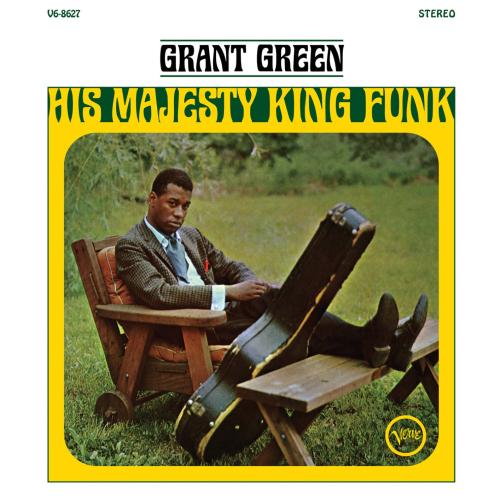
His Majesty King Funk (Remastered) Grant Green
Album Info
Album Veröffentlichung:
1965
HRA-Veröffentlichung:
27.11.2026
Das Album enthält Albumcover
Entschuldigen Sie bitte!
Sehr geehrter HIGHRESAUDIO Besucher,
leider kann das Album zurzeit aufgrund von Länder- und Lizenzbeschränkungen nicht gekauft werden oder uns liegt der offizielle Veröffentlichungstermin für Ihr Land noch nicht vor. Wir aktualisieren unsere Veröffentlichungstermine ein- bis zweimal die Woche. Bitte schauen Sie ab und zu mal wieder rein.
Wir empfehlen Ihnen das Album auf Ihre Merkliste zu setzen.
Wir bedanken uns für Ihr Verständnis und Ihre Geduld.
Ihr, HIGHRESAUDIO
- 1 The Selma March (Remastered) 08:25
- 2 Willow Weep For Me (Remastered) 09:59
- 3 The Cantaloupe Woman (Remastered) 04:52
- 4 That Lucky Old Sun (Just Rolls Around Heaven All Day) (Remastered) 05:17
- 5 Daddy Grapes (Remastered) 04:32
Info zu His Majesty King Funk (Remastered)
Ein Verve-Ausflug mitten in Grant Greenes Blue-Note-Jahren: „His Majesty King Funk“ verbindet klare Gitarrenlinien und tiefe Grooves mit einem ungewöhnlich aktuellen Signal – dem Stück „The Selma March“.
Grant Green zwischen Blue Note und Verve
1965 war Gitarrist Grant Green längst eine feste Größe bei Blue Note. Sein einziger Ausflug als Leader zu Verve wirkt deshalb wie ein Seitenwechsel, doch musikalisch bleibt er auf vertrautem Terrain. Für „His Majesty King Funk“, produziert von Creed Taylor und am 26. Mai in Rudy Van Gelders Studio aufgenommen, tat sich Green mit Musikern zusammen, mit denen er bereits gearbeitet hatte: Organist Larry Young, Saxofonist Harold Vick und Schlagzeuger Ben Dixon. Neu im Klangbild: Candido Camero an den Congas.
„The Selma March“: Jazz im Echo der Bürgerrechtsbewegung
Der Albumauftakt trägt den Namen eines historischen Moments. Im März 1965 zogen Bürgerrechtlerinnen und Bürgerrechtler von Selma nach Montgomery, um gegen die systematische Verweigerung des Wahlrechts für Schwarze Amerikaner zu protestieren. Die Märsche wurden zu einem Wendepunkt der Bewegung und ebneten den Weg für den Voting Rights Act. Green nahm „The Selma March“ zwei Monate später auf: ein Instrumentalstück, dessen Titel die Musik mitten in die politische Gegenwart seiner Zeit stellt.
Tiefer Groove, klare Linie
Greenes melodisch klare Gitarre trifft auf Youngs harmonisch bewegliche Orgel und Vicks blues- und gospelgefärbtes Tenorsaxofon. Dixon und Camero treiben die Band an, ohne den Stücken die Luft zu nehmen. Neben dem musikalisch aktuellen Auftakt zeigt das Programm Greens ganze Spannweite: „That Lucky Old Sun“ und „Willow Weep for Me“ geben ihm Gelegenheit, auch als Interpret von Standards zu glänzen. So klingt das Album zugleich nach Hard Bop, R&B und dem aufkommenden Soul Jazz – ein besonderer Moment in Greenes Katalog, den das audiophile Album Wiederveröffentlichung klarer denn je greifbar macht.
Grant Green, Gitarre
Harold Vick, Tenorsaxophon, Flöte
Larry Young, Hammond-B-3-Orgel
Ben Dixon, Schlagzeug
Candido Camero, Bongos, Congas
Aufgenommen am 26. Mai 1965 im Van Gelder Studio, Englewood Cliffs, NJ
Produziert von Creed Taylor
Digital neu abgemischt (remastered)

Grant Green
was born in St. Louis on June 6, 1931, learned his instrument in grade school from his guitar-playing father and was playing professionally by the age of thirteen with a gospel group. He worked gigs in his home town and in East St. Louis, IL, until he moved to New York in 1960 at the suggestion of Lou Donaldson. Green told Dan Morgenstern in a Down Beat interview: "The first thing I learned to play was boogie-woogie. Then I had to do a lot of rock & roll. It's all blues, anyhow."
His extensive foundation in R&B combined with a mastery of bebop and simplicity that put expressiveness ahead of technical expertise. Green was a superb blues interpreter, and his later material was predominantly blues and R&B, though he was also a wondrous ballad and standards soloist. He was a particular admirer of Charlie Parker, and his phrasing often reflected it. Green played in the '50s with Jimmy Forrest, Harry Edison, and Lou Donaldson.
He also collaborated with many organists, among them Brother Jack McDuff, Sam Lazar, Baby Face Willette, Gloria Coleman, Big John Patton, and Larry Young. During the early '60s, both his fluid, tasteful playing in organ/guitar/drum combos and his other dates for Blue Note established Green as a star, though he seldom got the critical respect given other players. He was off the scene for a bit in the mid-'60s, but came back strong in the late '60s and '70s. Green played with Stanley Turrentine, Dave Bailey, Yusef Lateef, Joe Henderson, Hank Mobley, Herbie Hancock, McCoy Tyner, and Elvin Jones.
Sadly, drug problems interrupted his career in the '60s, and undoubtedly contributed to the illness he suffered in the late '70s. Green was hospitalized in 1978 and died a year later. Despite some rather uneven LPs near the end of his career, the great body of his work represents marvelous soul-jazz, bebop, and blues.
A severely underrated player during his lifetime, Grant Green is one of the great unsung heroes of jazz guitar. Like Stanley Turrentine, he tends to be left out of the books. Although he mentions Charlie Christian and Jimmy Raney as influences, Green always claimed he listened to horn players (Charlie Parker and Miles Davis) and not other guitar players, and it shows. No other player has this kind of single-note linearity (he avoids chordal playing). There is very little of the intellectual element in Green's playing, and his technique is always at the service of his music. And it is music, plain and simple, that makes Green unique.
Green's playing is immediately recognizable -- perhaps more than any other guitarist. Green has been almost systematically ignored by jazz buffs with a bent to the cool side, and he has only recently begun to be appreciated for his incredible musicality. Perhaps no guitarist has ever handled standards and ballads with the brilliance of Grant Green. Mosaic, the nation's premier jazz reissue label, issued a wonderful collection The Complete Blue Note Recordings with Sonny Clark, featuring prime early '60s Green albums plus unissued tracks. Some of the finest examples of Green's work can be found there. ~ Michael Erlewine and Ron Wynn
Dieses Album enthält kein Booklet