



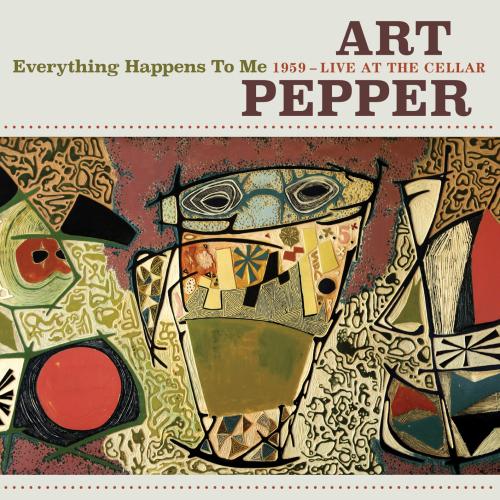
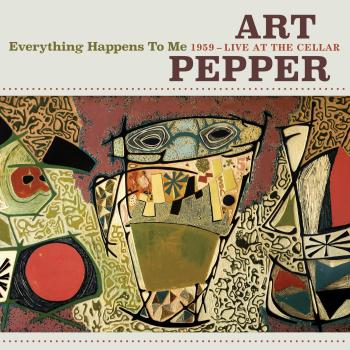
Everything Happens To Me: 1959 - Live At The Cellar (Mono Remastered) Art Pepper
Album Info
Album Veröffentlichung:
1959
HRA-Veröffentlichung:
20.02.2026
Das Album enthält Albumcover
Entschuldigen Sie bitte!
Sehr geehrter HIGHRESAUDIO Besucher,
leider kann das Album zurzeit aufgrund von Länder- und Lizenzbeschränkungen nicht gekauft werden oder uns liegt der offizielle Veröffentlichungstermin für Ihr Land noch nicht vor. Wir aktualisieren unsere Veröffentlichungstermine ein- bis zweimal die Woche. Bitte schauen Sie ab und zu mal wieder rein.
Wir empfehlen Ihnen das Album auf Ihre Merkliste zu setzen.
Wir bedanken uns für Ihr Verständnis und Ihre Geduld.
Ihr, HIGHRESAUDIO
- 1 When You're Smiling (Incomplete - Live at The Cellar, 1959) 00:59
- 2 Cherokee (Live at The Cellar, 1959) 07:58
- 3 Over The Rainbow (Version 1 – Live at The Cellar, 1959) 05:05
- 4 All The Things You Are (Live at The Cellar, 1959) 09:50
- 5 Indiana (Back Home In Indiana) [Live at The Cellar, 1959] 04:33
- 6 Lover Man (Live at The Cellar, 1959) 11:31
- 7 Yardbird Suite (Version 1 – Live at The Cellar, 1959) 11:29
- 8 Sweet Georgia Brown (Incomplete - Live at The Cellar, 1959) 08:21
- 9 What Is This Thing Called Love? (Live at The Cellar, 1959) 12:40
- 10 Yardbird Suite (Version 2 – Live at The Cellar, 1959) 08:44
- 11 Band Intros (Live at The Cellar, 1959) 00:48
- 12 What's New? (Incomplete - Live at The Cellar, 1959) 07:25
- 13 Holiday Flight (Version 1 – Live at The Cellar, 1959) 07:41
- 14 Stompin' At The Savoy (Live at The Cellar, 1959) 06:39
- 15 Allen's Alley (Version 1 – Live at The Cellar, 1959) 10:13
- 16 These Foolish Things (Remind Me Of You) [Incomplete - Live at The Cellar, 1959] 06:19
- 17 Holiday Flight (Version 2 – Live at The Cellar, 1959) 06:23
- 18 Tangerine (Live at The Cellar, 1959) 07:59
- 19 The Way You Look Tonight (Live at The Cellar, 1959) 05:56
- 20 Everything Happens To Me (Live at The Cellar, 1959) 06:33
- 21 Bernie's Tune (Live at The Cellar, 1959) 04:21
- 22 I Surrender Dear (Live at The Cellar, 1959) 07:52
- 23 Over The Rainbow (Version 2 – Live at The Cellar, 1959) 06:01
- 24 Allen's Alley (Version 2 – Live at The Cellar, 1959) 09:22
- 25 Brown Gold (Incomplete - Live at The Cellar, 1959) 07:56
- 26 Holiday Flight (Version 3 – Live at The Cellar, 1959) 04:30
- 27 Strike Up The Band (Live at The Cellar, 1959) 08:49
- 28 Somebody Loves Me (Live at The Cellar, 1959) 11:34
- 29 There Will Never Be Another You, Pt. 1 (Live at The Cellar, 1959) 02:47
- 30 There Will Never Be Another You, Pt. 2 (Live at The Cellar, 1959) 04:42
- 31 Allen's Alley (Version 3 – Live at The Cellar, 1959) 12:02
- 32 Walkin' (Incomplete - Live at The Cellar, 1959) 14:48
Info zu Everything Happens To Me: 1959 - Live At The Cellar (Mono Remastered)
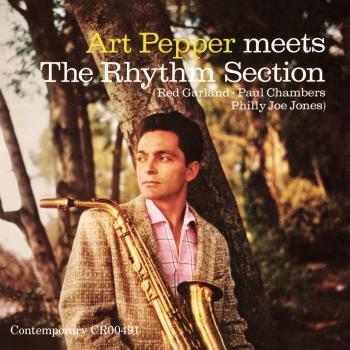
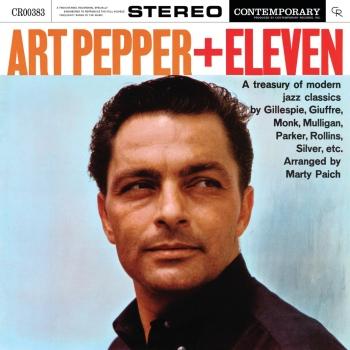
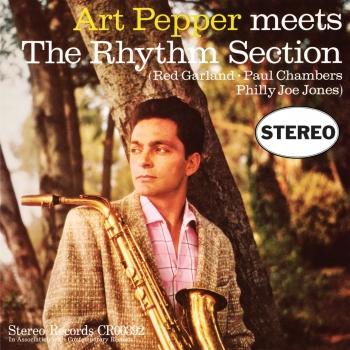
The release of Art Pepper’s Everything Happens To Me: 1959 – Live At The Cellar is the stuff music archivists can only dream of finding. Recordings by an historic and important jazz artist, at a storied venue, at a time when the artist was making some of their most essential work. In this case, catching Pepper on tape at The Cellar in 1959 finds him in the midst of creating and straddling landmark releases like, Art Pepper Meets The Rhythm Section (1957), Modern Art (1957), Art Pepper + Eleven (1959) and Gettin’ Together (1960). Though Pepper was going through a down time, Vancouver, Canada’s jazz club, The Cellar was in full swing and in the middle of its seven-year run (1956–1963).
There was an ongoing free exchange between the L.A. and San Francisco jazz players; the distance between the two cities amounted to six or seven hours by car. Sometimes a San Francisco booking stretched into stops in Portland and Seattle. Between 1956 to 1963, there was a northernmost jazz outpost in Vancouver, The Cellar. The basement space at 222 East Broadway (entered through the alley on Watson Street) grew from jam session site to full-fledged jazz club. —excerpt from liner notes by Kirk Silsbee
Dave Quarin, a saxophone player himself, managed The Cellar at the time, “The Cellar years were a good time for us,” Quarin states. “There were a half a million or so people in Vancouver then. We had CBC radio in the late 1950s, and they did live shows from Vancouver. We were very in-touch with American news, so I knew about the good musicians.” It was Quarin who captured Art on tape. Pepper was accompanied by pianist Chris Gage, bassist Tony Clitheroe and drummer George Ursan.
Everything Happens To Me: 1959 – Live At The Cellar utilizes a fly-on-the-wall approach that includes all the existing music as the recordings happened. As a result, the 4-CD / Digital set includes some incomplete tracks, but most songs run near to completion. The producers Laurie Pepper (Art’s widow) and Omnivore Recordings’, Cheryl Pawelski didn’t want to omit the near hour of additional music just because tape ran out on a track. Restoration and mastering engineer Michael Graves, restored and unified the existing audio to welcome you into The Cellar environment despite microphone placement changes within the club with nearly every change of tape.
Album notes by Kirk Silsbee include interviews with Laurie Pepper and Dave Quarin who also provided archival photos from the era, and the album art is built around the linocut that used to hang above the bar at The Cellar, a stunning piece called The Trio by Harry J. Webb (1954).
It’s not often that ephemeral moments at pivotal times during an artist’s career are captured such that nearly 70 years later they are ours to experience, but Art Pepper’s 1959 visits to The Cellar were transformative, “Pepper would later say that the experience was so emotionally satisfying that he would subse¬quently recommit himself to jazz.”
Art Pepper, alto saxophone
Chris Gage, piano
George Ursan, drums
Tony Clitheroe, double bass
Digitally remastered
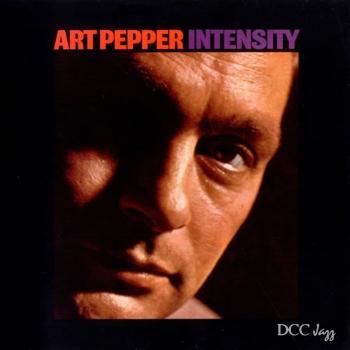

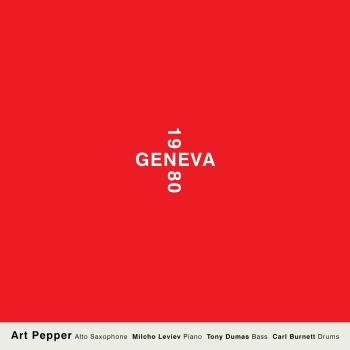
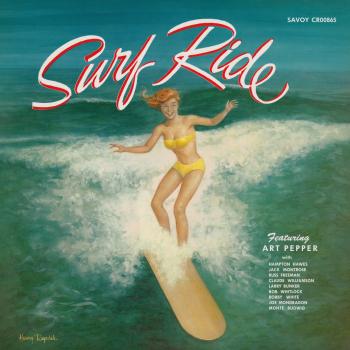
Art Pepper
born in Gardena, California on September 1, 1925 and raised in nearby San Pedro, began playing clarinet at age 9 and, by 15, was performing in Lee Young’s band at the Club Alabam on Central Avenue, the home of jazz in prewar Los Angeles.
He joined Stan Kenton’s band, touring the U.S. and gaining fame, but was drafted in 1943 serving as an MP in London and performing with some British jazz bands. He returned to the States and to Kenton, touring and recording. In 1952 he placed second only to Charlie Parker in the Down Beat jazz poll. Probably his most famous recording from that period is his stunning performance of “Art Pepper,” written by Shorty Rogers (as part of a series of charts Kenton had commissioned to feature members of his band).
Art left Stan Kenton in 1951 to form his own group, occasionally recording for Rogers and others. He signed with Contemporary Records in 1957.
From the beginning Art’s playing combined a tender delicacy of tone with a purity of narrative line—a gift for storytelling that was made irresistible by an inherent, dancing, shouting, moaning inability to ever stop swinging.
He was one of the few alto players to resist the style and tone of Charlie Parker. What he failed to resist was the lure of drugs, ubiquitous, at that time, among jazz musicians. And although some users managed to get through and over their addictions, Art, survivor of a rocky childhood (alcoholic neglectful mother, alcoholic violent father), unbalanced from the get-go, never did quite triumph over his, though he may have fought them to a draw.
So, in 1952, he began a long series of hospitalizations and incarcerations for violations of the drug laws of his time—possession, internal possession (“marks”), and then for violations of his previous releases (more possessions and internal possessions). In time, he became a petty thief, a real thief, a robber (though not an armed robber; his fellow criminals thought he was too crazy to be trusted with a gun). He served time for the Feds (Terminal Island) and for the State of California (San Quentin). He prided himself on being “a stand-up guy,” a good criminal.
All this history makes a pretty gripping story as it’s told by Art with his wife Laurie Pepper in their book, Straight Life (DaCapo). What’s surprising is that the music he managed to make during irregular bursts of freedom was enthralling, too. The gift was starved for the spotlight, for opportunities for performing and recording, but it flowered in the dark, became deeper and more soulful. The performances—from The Art Pepper Quartet (1952) and Art Pepper Meets the Rhythm Section (with Miles Davis’s rhythm section) on Contemporary (1957) all the way through the recordings he made at the Village Vanguard (Contemporary, 1977) and his later recording with strings (Winter Moon, Galaxy, 1981)—are brilliant, poignant, and a joy to hear. The rigor and abandon with which he lived his life were present in every note he played.
Art Pepper died June 15, 1982 of a cerebral hemorrhage. But the 1979 publication of Straight Life and accompanying press had revived Art’s career. With Laurie’s help, he spent the last years of his life trying to make up for lost time, making each performance a life-or-death occasion, touring worldwide with his own bands, recording over a hundred albums, writing songs, winning polls, respect, and adulation.
Most of his albums are still available for sale. Laurie Pepper is releasing the best of what remains unreleased and is working on a movie based on the book, Straight Life. •
Dieses Album enthält kein Booklet