
Album Info
Album Veröffentlichung:
1971
HRA-Veröffentlichung:
30.01.2026
Label: ECM Records
Genre: Jazz
Subgenre: Fusion
Interpret: Jan Garbarek, Bobo Stenson, Terje Rypdal, Arild Andersen, Jon Christensen
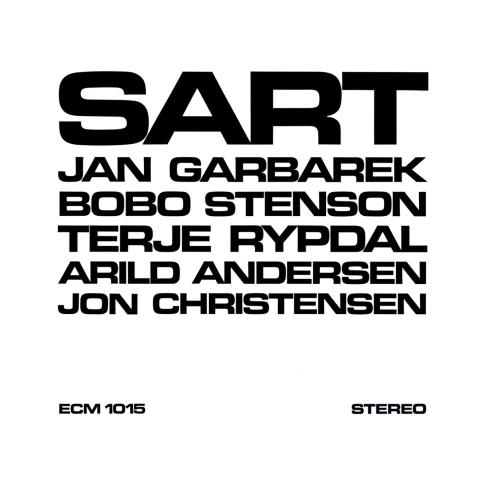
Das Album enthält Albumcover
Entschuldigen Sie bitte!
Sehr geehrter HIGHRESAUDIO Besucher,
leider kann das Album zurzeit aufgrund von Länder- und Lizenzbeschränkungen nicht gekauft werden oder uns liegt der offizielle Veröffentlichungstermin für Ihr Land noch nicht vor. Wir aktualisieren unsere Veröffentlichungstermine ein- bis zweimal die Woche. Bitte schauen Sie ab und zu mal wieder rein.
Wir empfehlen Ihnen das Album auf Ihre Merkliste zu setzen.
Wir bedanken uns für Ihr Verständnis und Ihre Geduld.
Ihr, HIGHRESAUDIO
- 1 Sart 14:45
- 2 Fountain Of Tears (Part 1 & 2) 06:03
- 3 Song Of Space 09:39
- 4 Close Enough For Jazz 01:59
- 5 Irr 07:15
- 6 Lontano 02:12
Info zu Sart (Remastered)
Sart is the third album by Norwegian saxophonist Jan Garbarek, recorded over two days in April 1971 and released on ECM later that year—his second release for the label. The quintet features pianist Bobo Stenson, guitarist Terje Rypdal, and Afric Pepperbird rhythm section Arild Andersen and Jon Christensen.
"Garbarek's second album for ECM found him conducting further explorations in two separate directions. On the one hand, his playing and, to some extent, his composing were becoming increasingly avant-garde, a path which would culminate in the ensuing Tryptikon disc. His stark cries clearly owed something to the then burgeoning AACM movement as well as to European musicians like Peter Brotzmann. At the same time, pieces like the title track here nodded toward the contemporary jazz-rock experiments of Miles Davis. "Sart"'s descending five-note theme and the space it leaves in its wake are reminiscent of one of Davis' approaches on records like Bitches Brew. Garbarek utilizes this structure to good dramatic effect, generating mini-climax after mini-climax, only to recede at the end. This was also the first collaboration with pianist Bobo Stenson who would become a regular associate of Garbarek's in upcoming years. His presence fills out the group sound quite nicely and serves as an agreeable counterpoint to Rypdal's playing, which, at this point, was still experimental and imaginative. Rypdal's atmospheric "Lontano," which closes the album, is a fine, brooding piece and one of the disc's highlights. A strong recording and, along with all of the other early ECM Garbarek releases, recommended for fans who came upon him much later in his career."(Brian Olewnick, AMG)
Jan Garbarek, tenor saxophone, bass saxophone, flute
Bobo Stenson, piano, electric piano
Terje Rypdal, guitar
Arild Andersen, bass
Jon Christensen, percussion
Digitally remastered
Jan Garbarek
As an improvising musician, Jan Garbarek has said that he seeks to make his playing “fit the tone, texture and temperament of the music. It’s about finding a common language.” The quest to explore that language has ranged widely across time and space, from the folk songs of his native Norway to improvisations around medieval polyphony and the music of the Indian subcontinent and Middle East, as well as jazz. In the course of these musical journeys, the intensely focused sounds of his tenor and soprano saxophones have become among the most instantly recognizable and haunting in contemporary music.
Garbarek was born in Mysen, Norway in 1947. His family later moved to Oslo and, at the age of 14, Garbarek first heard John Coltrane on the radio, which inspired him to take up the saxophone. Dexter Gordon, then a frequent visitor to Norway, also made a deep impression.
In 1962 Garbarek won a competition for amateur jazz players and for the rest of the decade worked regularly in Norway, usually as a leader, but he also spent four years with jazz composer and theorist George Russell, who would later describe him as “the most original voice in European jazz since Django Reinhardt”. In 1969, ECM founder Manfred Eicher asked Garbarek to join the roster of his new record label. Garbarek’s first ECM album was Afric Pepperbird. “After we recorded it we knew we had something special,” Eicher remembered. It was to be the first step in one of ECM’s most distinguished recording careers.
Jan Garbarek rose to international fame in the mid-1970s playing with Keith Jarrett's European Quartet, which released the albums Belonging, My Song and the live recordings Personal Mountains, Nude Ants, and Sleeper. Such collaborations, in the words of Jarrett’s biographer, Ian Carr, took “the art of classic jazz to its highest pinnacle”.
Triptykon (1972) was the first recording on which Garbarek used a Norwegian folk song in his playing, a direction in which he had been encouraged by American trumpeter Don Cherry. “Whether I like it or not,” Garbarek told one writer, “I am locked into a certain vocabulary or phraseology which is linked to Norwegian folk music.”
In 1979, Garbarek recorded Photo with Blue Sky, the first of a series of albums with the Jan Garbarek Group, a regular touring band whose line-up would evolve over the decades. It was not until 2007 that they recorded a live album, however, the double CD, Dresden. As the Guardian wrote of the group on their 2007 tour: “The contrast between an intense jamming sound and the songlike simplicity of the tunes is always Garbarek’s magic mix, but this version of the band has an exhilarating intensity.”
Officium, one of the most significant recordings of Garbarek’s career – and in the history of ECM – was made in 1993 in St Gerold monastery in Austria with the Hilliard Ensemble. Garbarek’s sax – a “fifth voice” – weaves soaring, swooping lines around the polyphony of the vocal quartet, creating effects that are as entrancing as they are unexpected. In 1999 came a sequel, Mnemosyne, which ranged further across time in its musical material, and Officum Novum explored the crossroads between east and west, with particular focus on the music of Armenia.
Garbarek’s restless musical imagination, so evident in his Hilliard collaborations and countless other projects over the years, keeps driving him forward. Of his musical journey he says: “It never really stands still. Not at any point in time can you say, ‘Now I reached something.’”
Dieses Album enthält kein Booklet