

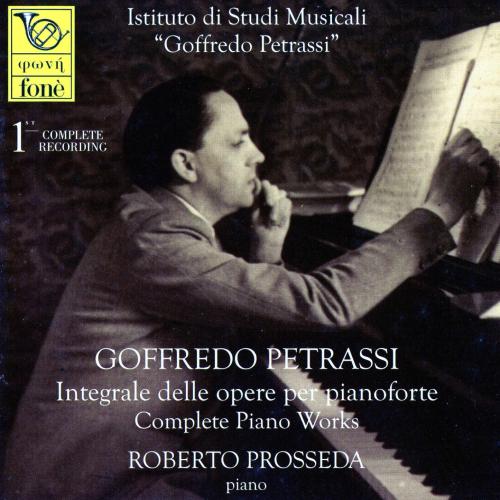
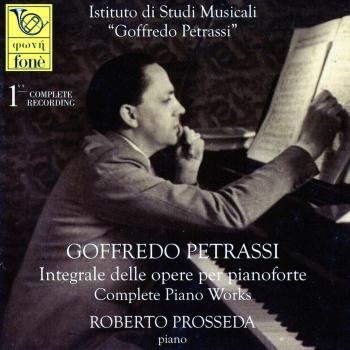
Petrassi: Complete Piano Works: Partita, Toccata, Invenzioni, Bagatella, Le Petit Chat Roberto Prosseda
Album Info
Album Veröffentlichung:
2000
HRA-Veröffentlichung:
18.01.2023
Label: fonè Records
Genre: Classical
Subgenre: Instrumental
Interpret: Roberto Prosseda
Komponist: Goffredo Petrassi (1904-2003)
Das Album enthält Albumcover Booklet (PDF)
- Goffredo Petrassi (1904 - 2003): Partita, I. Preludio:
- 1 Petrassi: Partita, I. Preludio: Allegro 02:27
- Partita, II. Aria:
- 2 Petrassi: Partita, II. Aria: Calmo con dolcezza 02:58
- Partita, III. Gavotta (grottesco) Moderato:
- 3 Petrassi: Partita, III. Gavotta (grottesco) Moderato 01:35
- Partita, IV. Giga:
- 4 Petrassi: Partita, IV. Giga: Vivace 01:42
- Siciliana e Marcia per pianoforte a 4 mani, Siciliana:
- 5 Petrassi: Siciliana e Marcia per pianoforte a 4 mani, Siciliana: Andantino 01:51
- Siciliana e Marcia per pianoforte a 4 mani, Marcia:
- 6 Petrassi: Siciliana e Marcia per pianoforte a 4 mani, Marcia: Allegro 01:20
- Toccata, Adagio – Presto – Adagio:
- 7 Petrassi: Toccata, Adagio – Presto – Adagio 07:28
- Piccola invenzione, Andantino:
- 8 Petrassi: Piccola invenzione, Andantino 00:58
- Invenzioni, I. Presto Volante:
- 9 Petrassi: Invenzioni, I. Presto Volante 01:18
- Invenzioni, II. Moderato – Più presto:
- 10 Petrassi: Invenzioni, II. Moderato – Più presto 03:02
- Invenzioni, III. Presto, leggero:
- 11 Petrassi: Invenzioni, III. Presto, leggero 01:35
- Invenzioni, IV. Moderatamente mosso, scorrevole:
- 12 Petrassi: Invenzioni, IV. Moderatamente mosso, scorrevole 03:16
- Invenzioni, V. Andantino, non molto mosso e sereno:
- 13 Petrassi: Invenzioni, V. Andantino, non molto mosso e sereno 04:11
- Invenzioni, VI. Tranquillo:
- 14 Petrassi: Invenzioni, VI. Tranquillo 02:49
- Invenzioni, VII. Scorrevole:
- 15 Petrassi: Invenzioni, VII. Scorrevole 03:20
- Invenzioni, VIII. Allegretto e grazioso:
- 16 Petrassi: Invenzioni, VIII. Allegretto e grazioso 02:25
- Petite pièce, Allegretto e grazioso con spirito [e comodità]:
- 17 Petrassi: Petite pièce, Allegretto e grazioso con spirito [e comodità] 01:51
- Oh les beaux jours! I. Bagatelle:
- 18 Petrassi: Oh les beaux jours! I. Bagatelle: Andantino, un poco mosso 03:33
- Oh les beaux jours! II. Le petit chat (Mirò):
- 19 Petrassi: Oh les beaux jours! II. Le petit chat (Mirò): Allegro [non presto] 03:32
- Conversazione con Goffredo Petrassi a cura di Raffaele Pozzi:
- 20 Petrassi: Conversazione con Goffredo Petrassi a cura di Raffaele Pozzi 15:37
Info zu Petrassi: Complete Piano Works: Partita, Toccata, Invenzioni, Bagatella, Le Petit Chat
Goffredo Petrassi's interest in the piano goes back to his first approaches to music. He himself remembers the curiosity aroused by an old Viennese instrument dated 1826 - a contemporary therefore of Beethoven -which was in the house of an uncle at Zagarolo, the small town in the Roman countryside where the composer was born on 16 July 1904. After moving to Rome at the age of seven, Petrassi entered the Schola Cantorum of San Salvatore in Lauro. It is known that the experience of boy chorister, which followed the old tradition for training musicians for the papal chapels, represented a spiritual and musical deposit of the maximum importance for the future composer. The developments of these preliminaries were however still distant. His activity as chorister ended with the change of voice and Petrassi, coming from a family of modest economic means, started to work at the age of fifteen as assistant in a music shop. The shop was subsequently taken over by the HP-FabbricaItalianaPianoforti (Italian Piano Manufactury) of Turin whose managing director was Guido MaggiorinoGatti, a leading organizer and music critic in Italy at that time; the shop then moved to Corso Umberto, not far from the Conservatoire of Santa Cecilia. There the youngster had the opportunity, in his free time, to read scores and parts playing, self-taught, a piano of the firm. These efforts, applied in particular to the Deux Arabesques of Claude Debussy, attracted the attention of Alessandro Bustini - at that time professor of piano at the Conservatoire-who offered to give him lessons on Sundays gratis. Under the guidance of Bustini, Petrassi began to study piano fairly regularly, applying himself to the traditional literature of the instrument, from Bach's Well-tempered Klavier to Chopin and Debussy. On the advice of Bustini, he started to study harmony with Vincenzo Di Donato in 1925, displaying a great talent for composition. His efforts were then directed towards entering the Conservatoire in the class of composition and, once an acceptable technical competence was reached, the piano was temporarily abandoned. The first compositions in the catalogue of Petrassi's works date back to the "apprenticeship" period with Di Donato: Egloga and Partita, both for piano, were composed in 1926 and played by the pianist Letizia Franco at the Sala Sgambati in Rome on 28 November of the same year during a public test of Vincenzo Di Donato's pupils. Egloga was never published and is today considered lost. Petrassi remembers adopting a musical scoring without bar-divisions, an ingenuous juvenile experiment influenced (according to him) by the reading of a piano piece by Federico Mompou, a twentieth-century stylistically Gallicized Catalan composer. The title of the composition, with its evocation of the classical-pastoral world, is proof of the literary interests of the young Petrassi and of his regard for the French cultural and musical tradition that was still alive in the Roman milieu, between the opposing forces of the followers of Ottorino Respighi, IldebrandoPizzetti and Alfredo Casella. Nor can a vague, perhaps unconscious, reference be excluded to the celebrated eclogue of Mallarme, L'Apres-midi d'un faun which inspired Debussy.
"This fine recording brings together all of Petrassi's piano works. It is excellently interpreted by Roberto Prosseda, who carves out this handful of works as a complex and eclectic sound world, rich in relations to the culture and compositional research of those contemporary musics." (Massimo Rolando Zegna, Amadeus, 1/2002)
"Do not expect tiring listening: just intense. This, judging by Prosseda's important performance, is to begin with the sensitivity of the performer. The continuous playing with the history of music and forms sounds endowed with a fascinating emotional and syntactic continuity." (Angelo Foletto, Suonare News, 1/2002)
"Roberto Prosseda has done a very praiseworthy job in taking up and performing Petrassi's music, succeeding in giving a musical sense, a precise and convincing character to the Inventions, which we have never heard so happily realised" (Riccardo Risaliti, CD Classics, 11/2001)
Roberto Prosseda, piano
Roberto Prosseda
born in Latina, Lazio, in 1975, is one of the most active and versatile Italian musicians on the current international scene. He gained international fame following his recordings of the complete Mendelssohn piano music (Decca, 2005-14), published in a box set in 2017.
Over the past twenty years Roberto has performed with some of the world’s leading orchestras and conductors. With the Gewandhausorchester and Riccardo Chailly, he recorded Mendelssohn’s then-unpublished E minor piano concerto. In Italy he is a regular guest at the major concert venues, including the Accademia Nazionale di Santa Cecilia, Teatro alla Scala, Unione Musicale in Turin, Teatro La Fenice, Accademia Chigiana (Siena) and Teatro Comunale (Bologna).
Roberto is particularly acclaimed for his interpretations of Mozart, Schubert, Schumann and Chopin. His six albums of Mozart piano sonatas for Decca have received considerable international acclaim. In 2022 Roberto completed a project to record the complete Mozart piano works. 2025 saw the release on Hyperion of War Silence, a collection of rare Italian piano concertos by Guido Alberto Fano, Luigi Dallapiccola, Silvio Omizzolo and Cristian Carrara, described in Gramophone magazine as ‘an absorbing listen’.
Since 2011 Roberto has also played the pedal piano in public, having re-discovered and presented in modern premieres various pieces by Alkan and Gounod’s Concerto for pedal piano and orchestra with Parma’s Filarmonica Arturo Toscanini. He has performed the latter also with the Berliner Symphoniker, Staatskapelle Weimar, Lahti Symphony and Netherlands Symphony orchestras, and for Hyperion recorded Gounod’s four pieces for pedal piano and orchestra with the Orchestra della Svizzera Italiana and Howard Shelley. Roberto has performed on the piano pedal in over 100 concerts, contributing to the revitalization of the instrument and its repertoire.
Roberto Prosseda is equally active as a music writer and author of radio and TV projects, as well as a creator of innovative musical programmes of international scope. He conceived three television documentaries, about Mendelssohn, Chopin and Liszt, directed by Angelo Bozzolini, produced by RAI and globally distributed by EuroArts. His book Il Pianoforte, a listening guide to piano repertoire, was published by Edizioni Curci in 2013.
Booklet für Petrassi: Complete Piano Works: Partita, Toccata, Invenzioni, Bagatella, Le Petit Chat