


Melissa Carper & Theo Lawrence
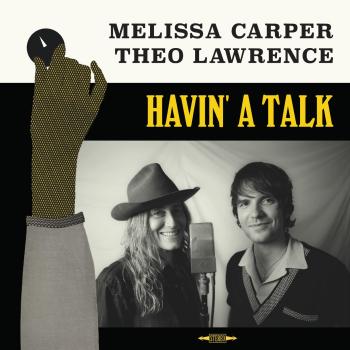
Biographie Melissa Carper & Theo Lawrence
Melissa Carper
Celebrated for her profoundly observational lyrics, her “homespun sensibility,” and a voice that curls like a croon from a gramophone, Melissa Carper plays old school country music that resonates across time and place. Carper’s repertoire weaves together the threads of old-time, bluegrass, western swing, jazz, and blues that all intertwined to form American country music, back in the days before the recording industry drew artificial lines and slapped on race-based genre labels. Veteran Nashville musician Chris Scruggs highlighted Carper’s versatile traditionalism when he dubbed her “HillBillie Holiday,” declaring, “She’s as good as it gets. She has a quality that really transcends time and fashion.”
Melissa Carper’s childhood in North Platte, Nebraska, was filled with country music. She has fond memories of lying on the living room carpet with her head under the family stereo console, listening to her parents’ beloved Hank Williams and Loretta Lynn albums. From an early age, the Carper siblings sang gospel music together at churches and retirement homes, and when the kids were old enough for instruments, their mother organized them into a country band. Having taken up upright bass in 4th grade, 12-year-old Melissa naturally became the electric bassist. A childhood playing country music until midnight on the circuit of Nebraska’s rural Elks, Eagles, and American Legion halls may have been out of the ordinary, but she reflects that “my parents were dreamers and they believed in all of us and our musical abilities.” Her high school band director, himself a bassist, was another mentor, and with his encouragement, she attended the University of Nebraska at Lincoln on a classical music scholarship.
Drawn more to gigging and to the jazz and blues recordings she discovered in the university’s library, Carper left school for Eureka Springs, Arkansas. Years of honing her craft as a busker in this cultural hub of the Ozarks deepened her devotion to country music, as did subsequent stints in the music meccas of New Orleans, New York, and her new hometown of Austin, Texas. Melissa Carper’s acclaimed debut solo album, Daddy’s Country Gold (2021), is something of a greatest hits album born of those formative years, and her subsequent recordings Ramblin’ Soul and Borned in Ya proved the staying power of her playful and profound songwriting.
Deep connections with other artists are essential to Carper’s success--her musical journey includes membership in beloved bands like the Camptown Ladies, Wonder Women of Country, The Carper Family, and Sad Daddy. Musical partnerships were the driving force behind two new 2025 releases, each highlighting not just Carper’s mastery of the genre but her willingness to step into a musical adventure in the company of good friends. First out of the gate are two new singles penned with her new pal Theo Lawrence, a native of Paris (France, not Texas). Released by Warner with hints of more music to come, “All Fifty States” and “Dat Ain’t Right” showcase two great songwriters exchanging playful banter with catchy, vibrant melodies. Then, just in time for the holidays, a Christmas album drops from Soundly/Thirty Tigers. Inspired by pal Ben Kitterman, who told her his family plays Daddy’s the whole month of December each year, Carper set to work writing. Collaborating with wordsmith Gina Gallina, a buddy since their days busking in New Orleans, A Very Carper Christmas spins out a raft of instant holiday classics recorded with a bevy of friends and, in honor of Melissa’s mother, a very tasty cheeseball.
Melissa Carper is a musical traditionalist for the modern age. “Melissa’s songs all come from the heart. She don’t blow smoke,” says musical co-conspirator Gallina. Carper’s unassuming yet unapologetic queerness, combined with her experiences wandering and finding a new home in diverse communities, reinforced her innate ability to channel into her songs the beauty, struggles, and humor of everyday life—a key component of the best kinds of country music. This deeply humanitarian impulse also drives her efforts to build the Natural State of Being Farm, a small-home community in Arkansas (The Natural State) designed to combat homelessness and support recovery. It also comes through loud and clear in her riveting stage shows and her growing body of essential country songs. "It's a tricky thing that Carper has done,” declares roots journal No Depression. “[She’s] carefully preserving the sense of romance and immediacy of the old classics. Yet by bringing her own experiences into the canon, she is unearthing a history that includes so many more of us, finally allowed to speak out through memories forgotten due to silence and taboo."
Theo Lawrence
Growing up in Paris, France, Austin-based country singer/songwriter Theo Lawrence was surrounded by pop and hip-hop music. His affinity for old country music distinguished him from his peers, and drove him to spend hours pouring over albums and concert recordings checked out from the local media lending library. While his peers listened to modern pop, Lawrence devoured Hank Williams, Loretta Lynn, Elvis, Carl Smith, Jim Reeves, and Kitty Wells.
“What really rocked my world at that time was seeing footage of bands and artists play that music. My father rented the Woodstock festival for me on DVD and we'd watch The Who and Jimi Hendrix and people really being electrified on stage,” Lawrence says. “That was my gateway to being really passionate about it is, is seeing the people on stage doing their thing, and then it makes a total portrait in your mind.”
Just as it has for so many other Americana artists, that early infatuation transformed into a deep reverence for the stories and people in country music and years spent seeking out that music and learning to make it himself. These days Lawrence is becoming a fixture of Austin’s country music scene, known for his sharp style and spot-on country sound and songs that sound directly out of the Marty Robbins and George Jones canon.
Lawrence’s 2023 debut country album, Chérie, opens with “California Poppy,” a twangy guitar-driven road trip story about a fling gone wrong, establishing his hard-won credentials from the start. Like any good country album, Chérie, which is full of syrupy guitar twang, and whiny fiddle, wallows in heartbreak — “Now That You’re Gone,” “How Do I Learn to Lose,” and “A Dime for a Nickel” — cuts loose for dance numbers — “The Universe Is Winding Down” and “Every Wish” — and conjures a few good, funky characters — “Liquor and Love,” “Kitty Cat Clock,” and “Keechie & Bowie,” a bandit story and “Pancho and Lefty” homage.
As an American country music-obsessed kid growing up in Paris, Lawrence was fascinated by everything from how the musicians he saw in the concert recordings dressed, to how they played, and who did what in the background. Soon he got a guitar and learned to sing along. And the minute he mastered a couple chords, he began writing music. Lawrence’s artist parents both followed non-traditional career paths, and when they saw him losing interest in typical school subjects, they encouraged him into music.
“I didn't really have any passion or anything like that, so it was a very instant calling — ‘this is going to be my thing, I'm going to play guitar, sing songs, write my songs, and play in a band.’ It was [a] point of no return,” Lawrence says.
Still, Lawrence’s early bands weren’t really country, because none of his musical friends knew country music. And old country music remained more of a private hobby until Lawrence met Thibault Ripault who shared his affinity. Their band together played classic country music, and Lawrence set about learning to write songs for them to play.
“I was getting a little frustrated to see that there was such a gap between the music that I was listening to and music that I was making,” Lawrence says. “He was the first person that I met that was part of my age group that made me feel like it was okay to really lean in the country sound and do it unapologetically.”
Writing like the old country music Lawrence loved felt like a code he needed to crack. Diligently he listened over and over, dissecting the albums sonically so he could sort out songs’ rhythm, the arrangements, what guitar was used and who played it, and the harmonies, in order to ape each component himself when he wrote and recorded songs.
“My goal was that nobody could tell that it was me who wrote them,” Lawrence says. “My goal was to write songs that any of these artists could have sung. And write classic country songs that could have been just part of the repertoire at that time.”
With Ripault, Lawrence traveled to Austin for the first time in 2019. They rented gear and a house for a month, intent on learning the scene and its players with an outside goal of playing maybe one gig while they were there. Three days after landing, they had their first gig, and soon booked another and another, filling nearly the whole month with shows.
At their first American gig – at Sam’s Point – Lawrence felt at ease in a way he never had before in his years as a musician. And repeatedly during that first month-long trip to Austin, Lawrence was blown away as he watched the audience two stepping and listening intently, their joy readily apparent. ...