



Tuff Times Never Last Kokoroko
Album info
Album-Release:
2025
HRA-Release:
14.07.2025
Album including Album cover
I`m sorry!
Dear HIGHRESAUDIO Visitor,
due to territorial constraints and also different releases dates in each country you currently can`t purchase this album. We are updating our release dates twice a week. So, please feel free to check from time-to-time, if the album is available for your country.
We suggest, that you bookmark the album and use our Short List function.
Thank you for your understanding and patience.
Yours sincerely, HIGHRESAUDIO
- 1 Never Lost 04:23
- 2 Sweetie 04:04
- 3 Closer To Me 05:23
- 4 My Father in Heaven 02:29
- 5 Idea 5 (Call My Name) [feat. LULU.] 04:51
- 6 Three Piece Suit (feat. Azekel) 04:34
- 7 Time and Time (feat. Demae) 03:14
- 8 Da Du Dah 03:48
- 9 Together We Are 03:40
- 10 Just Can't Wait 06:22
- 11 Over / Reprise 06:45
Info for Tuff Times Never Last
Tuff Times Never Last’ is a spirited and vibrant collection of songs serving as an optimistic reminder to tightly hold and embrace the many dualities that occur in life. Over the course of the 11-song suite, the album explores togetherness, community, sensuality, childhood, loss and above all perseverance.
Initially drawing inspiration from a viral social media meme, co-bandleader Onome Edgeworth said of the title’s origins and meaning: “It’s true! Although we’re reflecting on joy and celebration, you realize that a lot of that beauty comes out of challenges and difficulties. It felt like a natural truth that we discovered whilst writing”.
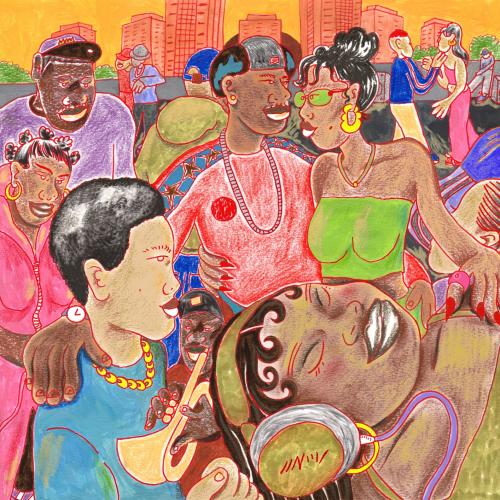
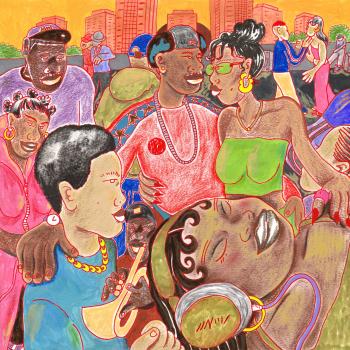
The accompanying artwork was painted by Luci Pina, the acclaimed illustrator whose work has been sought and commissioned by the likes of The Cut, Soho House, DICE, Apple Music and It’s Nice That. Embedded within the image is Kokoroko’s ode to London in the summer. Speaking on its design, co-bandleader Sheila Maurice-Grey said: “The remit was summer in London, family and sense of everyone being in a congregation-like audience, and us being the musicians”.
The artwork’s imagery and colour was inspired by feelings of innocence and nostalgia - coming of age in London and those rare summer nights where everything felt full of hope. The cityscape also pays homage to Spike Lee’s 1994 film ‘Crookyln’ and Rick Famuyiwa’s 1999 opus ‘The Wood’. The band saw these movies as heartwarming representations of black family, community and resilience that served as a balm for them as Londoners. Speaking further on this, co-bandleader Onome Edgeworth said: “‘Crooklyn’ is very emotional, but also very uplifting. It felt like how I grew up. This album is us sharing our own feelings, hopes and dreams. We didn’t always have those stories in the UK”
Three years on from their debut album ‘Could We Be More’ which peaked at No.30 on the UK Albums Chart and received acclaim from The Guardian, The Telegraph, Financial Times, Jazzwise, CRACK Magazine and Downbeat Magazine, ‘Tuff Times Never Last’ sees the London band with careless abandon expand their wide-ranging palette and influences.
While the afrobeat jazz of their previous work is still a core part of the record’s sonic design, the new album largely pulls from British R&B from the 80s, neo-soul, West African disco, bossa nova, lovers rock and funk. Sonically taking cues from the likes of Loose Ends, Don Blackman, Common, Sly & Robbie, William Onyeabor, Patrice Rushen, Ofori Amponsah and Cymande. Throughout this instinctive evolution, the septet's seasoned musicianship preserves the essence of who Kokoroko are as masterful jazz artisans.
Speaking on the band’s progression in sound, co-bandleader Sheila Maurice-Grey said: “Innately, we’re jazz musicians but we've tried not to kind of box ourselves into one sound. So there is a level of freedom we're starting to feel. We want to continue being as creative as possible without feeling any boundaries”.
The unveiling of the new album comes alongside the LP’s lead single ‘Sweetie’, a tantalising first taste of the new record that bridges the gap between where the band has been and where they’re going. A tribute to the playful bond between lovers, ‘Sweetie’ is a horn-led and wonky-sounding tune saluting West African disco. It expands upon the band exploring more electronic sounds and toying with obscure drum machine and synth sounds.
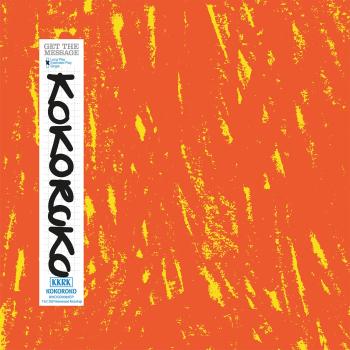
‘Sweetie’ marks Kokoroko’s first dose of new music since their EP ‘Get The Message’. Released last November, the project spawned ‘Three Piece Suit’ featuring Azekel - their honouring of Nigerian elders contemplating home, lineage and ancestry in 1960s London.. Upon its release, the EP earned praise from Rolling Stone Africa, Bandcamp Daily, The Fader, YAMS, OkayAfrica, TRENCH, Official Charts, NOTION, CLASH, DMY, Rough Trade and The Stranger.
Kokoroko
Engineered by Christoph Hans Skirl
Mixed by Dilip Harris
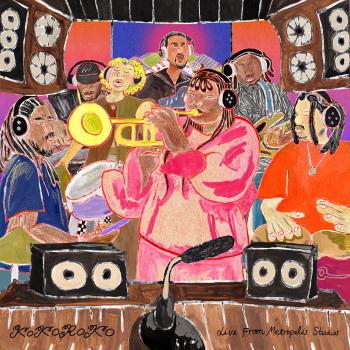
Mastered by Stuart Hawkes at Metropolis Studios, London
Produced by Miles Clinton James
Kokoroko
first formed in 2014 when Sheila Maurice-Grey (trumpet/flugelhorn/vocals) and Onome Edgeworth (percussion) met on an arts trip in Kenya, bonding over their shared tastes in music. A desire to connect young people in the African diaspora with genres like Afrobeat and Highlife would also fuel the band’s genesis. Before long they were playing gigs, riding a wave of the then nascent “London jazz scene”. In 2018, their breakthrough was secured when the sparse ‘Abusey Junction’ was included on Gilles Peterson’s ‘We Out Here’ compilation. An understated 7 minute ballad recorded in an afternoon, it quickly became a viral hit racking up 75 million streams.
The next few years were spent touring extensively, work-shopping their music and perfecting their sound. In 2019 they self-released their debut EP in 2019, selling over 20,000 copies on vinyl, before having its momentum halted by the pandemic. In 2022, after much heightened anticipation, and with the help of producer Miles James (Little Simz, Yussef Dayes, Tom Misch), they released their debut album ‘Could We Be More’. A sinewy blend of afrobeat, highlife and jazz, the album scored platitudes from The Guardian, The Telegraph, Financial Times, CRACK Magazine and plethora of others. The album would also land a top 40 placement on the UK Albums Chart, peaking at No. 30.
Its resulting success parlayed into an extensive number of touring and festival dates across Europe, Australia, and Canada. Now a decade into their existence, the ensemble who also consists of Anoushka Nanguy (vocals/trombone), Ayo Salawu (drums), Duane Atherley (bass), Tobi Adenaike-Johnson (guitar) and Yohan Kebede (keys) are in a place where they’ve done their bit in contributing to a necessary course correction for the scenes they sought to revitalise. And as such, feel ready to sonically expand their horizons.
The first major artistic leap from the confines of being called a “London Jazz Band” came with ‘Could We Be More Remixes’. Featuring contributions from KeiyaA, Ash Lauryn, Stefan Ringer, Vanyfox and Hagan, the original songs were re-imagined through a club lens. Allowing the band’s music for the first time to cross into the worlds of afro-house, amapiano, Detroit house, future bounce and techno.
Kokoroko’s artistry has matured to a place that’s now largely representative of the musical melting point and wide range of tastes that comes as Londoners in the black diaspora. It’s this precise notion and the sense of London as an overarching anchor that informs the crux of their forthcoming second studio album ‘Tuff Times Never Last’.
Set for release on July 11th via Brownswood Recordings, ‘Tuff Times Never Last’ is a body of work that holds space for the many dualities that occur in life. A testament to resilience, joy and the retainment of child-like innocence in the face of adverse circumstances. “Although we’re reflecting on joy and celebration, you realize a lot of that beauty comes out of challenges and difficulties. Even in memory, the times that were tough tend to sweeten up” Edgeworth says of the story behind the album’s title.
The imagery and colour laden in the album’s accompanying artwork evoke feelings of warmth, innocence and nostalgia – coming of age in London and those rare summer nights where everything felt full of hope. The painting was crafted by Luci Pina, the acclaimed illustrator whose work has been sought and commissioned by the likes of The Cut, Soho House, DICE, Apple Music and It’s Nice That. Speaking on its design, co-bandleader Maurice-Grey said: “The remit was summer in London, family and sense of everyone being in a congregation-like audience, and us being the musicians”.
The cityscape pays homage to Spike Lee’s 1994 film ‘Crooklyn’ and also films like Rick Famuyiwa’s 1999 opus ‘The Wood’, ‘Love and Basketball’ and ‘Poetic Justice’. The band saw these movies as heartwarming representations of black family, community and resilience – serving as a balm for them as Londoners. Speaking further on this, co-bandleader Onome Edgeworth said: “‘Crooklyn’ is very emotional, but also very uplifting. It felt like how I grew up. We didn’t always have those stories in the UK. Even to this day, if I want to feel good, that’s what I go back to”
Embedded within the backstory behind the artwork is a gentle yet incisive commentary on the often-misconstrued narratives, pertaining to the lived experience of black communities in the UK. “I went to school in Brixton, to me it never felt dangerous”, Maurice-Grey reflects. Adding, Edgeworth notes. “To us, if you grew up in an estate in the summer, it was the sweetest thing in the world. An African home with 10 cousins barbecuing and music blazing from every car and house”.
Aiming to signal an air of triumph, victory and celebration in its musicality, the new record sees the London band with careless abandon expand their wide-ranging palette and influences. Across the album’s 11 songs, Kokoroko venture in and around 80s Brit-funk, neo-soul, West African disco, bossa nova, lovers rock and funk. Radiating in just over 40 minutes, a universal portrayal of black diasporic music sounds from decades gone by to the present day. Showcasing their implicit and explicit connections, especially in the realms of music made for the dancefloor. “It’s all black electronic music to us. Whether it’s here in the UK, Chicago, Jamaica or West Africa”.
Much of the album sees the ensemble embracing a tone that’s more upbeat and party-orientated. “We tour so much so you want it to be fun. When all your songs are so serious and intense, you miss out on enjoying yourself sometimes. We asked ourselves the question, “What do we want our next years to feel like?” And we wrote music with the intention of it having colour and a sense of playfulness”, Edgeworth says of their decision to veer into more up-tempo territory.
Over the album’s 2-year recording and gestation process, the band developed a strong affinity for vintage studio gear, MPC drum machines and psychedelic synth sounds. For Maurice-Grey, it was their experimentation with such equipment which propelled this shift.
The work of Nigerian disco and electro-funk musician William Onyeabour, as well as artists like Steve Monite and Ofori Amponsah would come to serve as a significant north star for the album’s sonic design, highly inspiring the new record’s lead single ‘Sweetie’. A tribute to the playful bond between lovers, the track is a horn-led and wonky-sounding tune saluting West African disco and boogie.
‘Sweetie’ forms part of a triad of tracks on the new record that bridges the gap between where the band has been and where they’re going. The album’s sixth track ‘Three Piece Suit’ featuring alternative R&B maven ‘Three Piece Suit’ was first released on the band’s 2024 EP ‘Get The Message’, while opening track ‘Never Lost’ was first debuted live at their 2023 Meltdown Festival show curated by Christine & The Queens. These songs provide their core audience with the “classic” hallmarks of Kokoroko’s sound but in a way that feels progressive and elevated.
The remainder of the project sees the septet pulling from a diverse palette of reference points. Sonically taking cues from the likes of Loose Ends, Don Blackman, Common, Sly & Robbie, Patrice Rushen and Cymande. On the band’s progression and evolution, Maurice-Grey said: “Innately, we’re jazz musicians but we’ve tried not to kind of box ourselves into one sound. It’s music you can definitely step to and bolder than anything we’ve done before”.
Their experimentation in parts veers towards avant-garde and psychedelic sound terrain on closing track ‘Over / Reprise, but most especially on ‘We Are’. A funk-infused bossa nova groove that in the first instance recalls the lavish and sophisti-pop sound of Sade and Incognito before evolving into a trippy, distorted, and nearly electronic landscape.
There is notably greater emphasis on constructing tracks with strong, catchy hooks and tracks that follow more of a standard and formalised song structure. “We’re more interested in songwriting in a way that we haven’t always been. Before, it was all about creating a sense of energy. It’s been nice writing songs that work for themselves, rather than us having to depend on our musicality”, Edgeworth asserts.
A noteworthy moment on the album is ‘My Father’ which has vocals delicately arranged in a way akin to the R&B vocal groups of the 90s. Stripped back and almost acapella, the song beholds a position as one of the project’s few moments of stillness and introspection. “Similar to ‘Never Lost’, that song is very much about the faith between a person and their father in heaven. But it could also be seen as a parental or a familial love”, Maurice-Grey notes.
A palpable ambience of romance, yearning and sensuousness permeates much of the album’s tracks, signalling their allegiance to the lovers. “Especially as musicians, you can feel like you don’t want to write about love because everyone’s writing about love”, Maurice-Grey remarks. The decision to lean more into a vulnerable space resulted in two of the project’s resolute highlights; the sensuous ‘Time and Time’ featuring Demae and the record’s second single ‘Closer To Me’. “Closer To Me’ in its essence recalls the fabled Soulquarians era. “That song is a Hip-Hop record at its core. It doesn’t have any rapping on it, but the drums, the sampling and the feeling of it is very Hip-Hop. It’s like the old Common records”, Edgeworth notes.
The collective’s growth as songwriters shines most emphatically and exuberantly on ‘Da Duh Dah’ and ‘Top Gun’. Gems on the album which are reminiscent of British soul bands like Loose Ends and 52nd Street. Stalwarts and architects of contemporary black British music as we know it who over time have become obscured and lost to history. For Maurice-Grey who’s stunning alto leads the vocal on both tracks, referencing these groups was just tantamount to what has always been Kokoroko’s mission. “Although we started off playing heavily afrobeat and highlife, the core of us was always to kind of pay homage to those who came before us”.
More than just an extension to the band’s growing catalogue, ‘Tuff Times Never Last’ is the culmination of Kokoroko at their optimum best. As is the way with many jazz collectives, members have come in and out of the fold with previous alumni Oscar Jerome, Cassie Kinoshi, Mansur Brown and Yussef Dayes going on to great successes in their own right. “It’s all been a part of the growing process. They’ve all added so much of the journey. And I think without them, I don’t think we would be where we are now”, Maurice-Grey shares. It’s these experiences that have strengthened the bond and sense of camaraderie among the current make-up of the group. “We’ve had more time with these guys than we did with anyone else. We’ve learned to give a lot of space to each other’s creativity, kinks and personalities”, Edgeworth says.
For the first time in their career, Kokoroko have their own studio space. This newfound space has become a sanctuary for innovation and spontaneity. Enabling them to distill their creative juices as a unit and really hone in on a sound that is singular and cohesive. As Kokoroko prepares to share ‘Tuff Times Never Last’ with the world, they stand at a vibrant watershed moment in their careers. With their roots firmly planted in the past with a vision gleaming towards the dreams of tomorrow, Kokoroko invites us to join them in this next chapter. “We’re in a luxury place where we can start sharing music as ourselves”, Edgeworth says. Echoing this sentiment, Maurice-Grey says, “There is a level of freedom we’re starting to feel. If we want to do XYZ, we might not do it amazingly, but we feel the freedom to explore that”. (Written by Sope Soetan)
This album contains no booklet.