



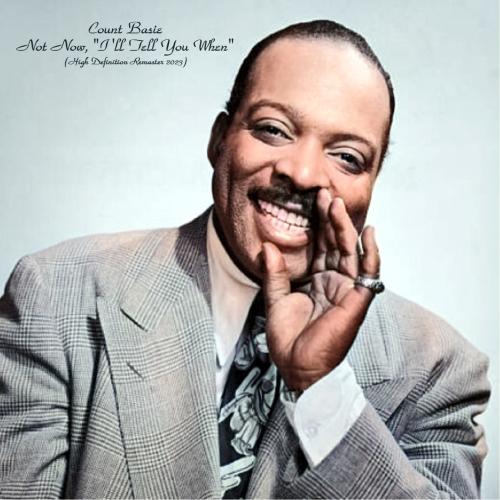
Not Now, "I'll Tell You When" (High Definition Remaster 2023) Count Basie
Album info
Album-Release:
2023
HRA-Release:
05.05.2023
Album including Album cover
- 1 Not Now, I'll Tell You When (Remastered 2023) 03:38
- 2 Rare Butterfly (Remastered 2023) 04:35
- 3 Back To The Apple (Remastered 2023) 04:43
- 4 Ol' Man River (Remastered 2023) 04:52
- 5 Mama's Talkin' Soft (Remastered 2023) 04:27
- 6 The Daly Jump (Remastered 2023) 04:08
- 7 Blue On Blue (Remastered 2023) 02:50
- 8 Swinging At The Waldorf (Remastered 2023) 03:41
- 9 Sweet And Purty (Remastered 2023) 03:23
Info for Not Now, "I'll Tell You When" (High Definition Remaster 2023)
Originally written under the title 'Super Chief,' this Thad Jones arrangement is now known as the title track from the Count Basie Orchestra's 1960 album 'Not Now, I'll Tell You When.' Jones's writing is at its creative peak throughout, making use of his trademark dissonant blasts alongside some deftly clever rhythmic tricks that make for an overall riveting listening experience.
As is the case with so many Basie arrangements, things start off with a brief solo piano introduction followed by a couple choruses of blues to set the mood. The full band enters at measure 22, with a rapidly rising melody line that begins in the band's bottom half before rising up to the upper reaches of the trumpets' registers. The band plays two excited, but relatively brief shout choruses at measures 30 and 55, with a couple more piano solo choruses sandwiched in-between. The energy level of the performance should be at close to full bore right from the start, and not let up throughout the entire arrangement.
The band officially claims the spotlight for itself at measure 80. A somewhat bop-influenced melody line here gives way to a more traditional call-and-response between the brass and the saxes at measure 92. The arrangement's blues form gets briefly elongated at this point to allow for drummer Sonny Payne to show off a bit at measure 100. The drum solo is followed by yet another joyously raucous ensemble shout at measure 108 before a recap of the introduction occurs. Jones finishes things off by dipping into his back catalogue, as the end of the arrangement is recycled from his composition 'Let's,' originally recorded in small group form in 1956. This section will require your band's internal metronomes to be operating at peak efficiency to prevent missteps, but when executed correctly it will undoubtedly create quite the thrill for performers and audiences alike.
This publication was prepared from Thad Jones's score and the original set of parts used during the 1960 recording session - this is not a transcription.
Count Basie, piano
Sonny Cohn, trumpet
Thad Jones, trumpet
Joe Newman, trumpet
Snooky Young, trumpet
Henry Coker, trombone
Al Grey, trombone
Benny Powell, trombone
Marshal Royal, alto saxophone, clarinet
Frank Wess, alto saxophone, tenor saxophone, flute
Frank Foster, tenor saxophone
Billy Mitchell, tenor saxophone
Charlie Fowlkes, baritone saxophone
Freddie Green, guitar
Eddie Jones, bass
Sonny Payne, drums
Digitally remastered
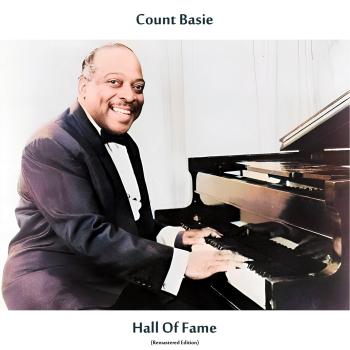
Count Basie
He played for kings and queens and presidents, but at the piano or leading his groundbreaking orchestra, William “Count” Basie was the embodiment of entertainment royalty.
Growing up in Red Bank, Basie learned the value of hard work. His father was a coachman, groundskeeper, and handyman for wealthy families in the area. His mother was a laundress. Lillian Basie also played piano and gave her son his first lessons on the keyboard.
Although a good student, Basie dropped out of junior high school to pursue a career in entertainment. He did chores at the local Palace Theater and quickly learned how to operate the lights for vaudeville shows. In no time, he was improvising piano accompaniment for silent films. Playing both piano and drums, Basie performed at dances and amateur shows, landing gigs in Asbury Park and other Jersey Shore towns.
Around 1920, Basie, still in his teens, moved to Harlem to seek opportunities and connect with the more-accomplished New York musicians. Basie made connections and soon was touring as an accompanist as far west as Kansas City and New Orleans. Returning to Harlem, he met the legendary keyboardist Fats Waller, who gave Basie informal lessons on the organ.
Later in the 1920s, Basie found himself stranded in Kansas City. He remained–and joined a band led by fellow pianist Bennie Moten. Together, they pioneered an upbeat style of jazz called Kansas City Stomp. Eventually, Basie started his own nine-piece band, the Barons of Rhythm, with future jazz icon Lester Young on tenor saxophone. One night, during a live radio performance with the band, the announcer gave Basie the name “Count,” to put his music in a class with Duke Ellington.
Another of those radio performances resulted in the band’s discovery by the influential talent scout John Hammond, who produced Basie’s earliest recordings. Basie next moved his band to New York, bringing their lively “jump” sound to such popular venues as the Roseland Ballroom and the Savoy. At various times, the band featured such fabulous vocalists as Billie Holiday, Jimmy Rushing, and Helen Humes. Basie himself wowed audiences with his spare, blues-oriented playing.
By the 1940s, Basie’s band—now the Count Basie Orchestra—was firmly established as one of the most successful attractions of the Swing Era. They played major engagements across the country, appeared in numerous movies, and scored nationwide hits with such Basie-penned swing classics as “Jumpin’ at the Woodside” and his signature tune, “One O’Clock Jump.”
The swing-era faded after World War II, but by then Basie was firmly in the entertainment elite. In the ensuing decades, he continued to tour around the world; made frequent television appearances; performed at one of President John F. Kennedy’s inaugural balls in 1961; and cut memorable recordings with the likes of Ella Fitzgerald, Duke Ellington, Oscar Peterson, and fellow future New Jersey Hall of Famers Sarah Vaughan and Frank Sinatra.
Truly a member of entertainment’s pantheon, Basie was the recipient of nine Grammy Awards; a Grammy Lifetime Achievement Award; a Kennedy Center Honors award; an NEA Jazz Masters Award; and posthumously, the Presidential Medal of Freedom. New Jersey commemorates Basie with the Count Basie Performing Arts Center in his native Red Bank.
This album contains no booklet.