


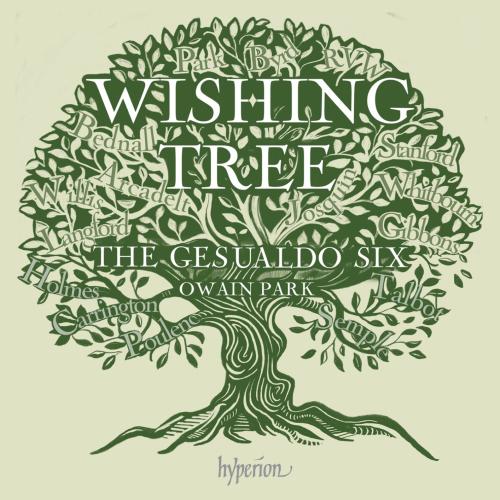
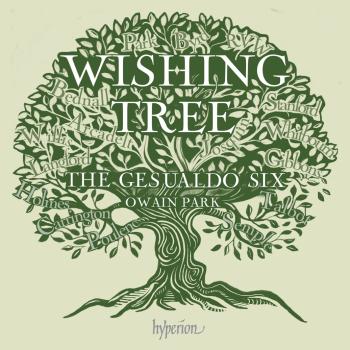
Wishing Tree The Gesualdo Six & Owain Park
Album info
Album-Release:
2026
HRA-Release:
05.06.2026
Label: Hyperion
Genre: Classical
Subgenre: Vocal
Artist: The Gesualdo Six & Owain Park
Composer: William Byrd (1543-1623), Josquin Desprez (1440-1521), Orlando Gibbons (1583-1625), Gordon Langford (1930-2017), Owain Park (1993), Francis Poulenc (1899-1963), Anna Semple (1997), Charles Villiers Stanford (1852-1924), Joby Talbot (1971), Ralph Vaughan Williams (1872-1958)
Album including Album cover Booklet (PDF)
I`m sorry!
Dear HIGHRESAUDIO Visitor,
due to territorial constraints and also different releases dates in each country you currently can`t purchase this album. We are updating our release dates twice a week. So, please feel free to check from time-to-time, if the album is available for your country.
We suggest, that you bookmark the album and use our Short List function.
Thank you for your understanding and patience.
Yours sincerely, HIGHRESAUDIO
- William Byrd (1539 - 1623):
- 1 Byrd: This Sweet and Merry Month of May 02:59
- David Bednall (b. 1979):
- 2 Bednall: Put Out Into the Deep 05:32
- Ralph Vaughan Williams (1872 - 1958):
- 3 Vaughan Williams: Bushes and Briars 03:04
- Alison Willis (b. 1971):
- 4 Willis: The Wind's Warning 04:13
- Joby Talbot (b. 1971):
- 5 Talbot: The Wishing Tree 03:48
- Traditional:
- 6 Traditional: The Oak and the Ash (Arr. Langford for Vocal Ensemble) 03:25
- Anna Semple (b. 1997):
- 7 Semple: My Bonny Lies (Arr. Park for Vocal Ensemble) 02:45
- Josquin des Prez (1450 - 1521):
- 8 des Prez: El grillo 02:32
- Christen Holmes (b. 2000):
- 9 Holmes: Summer Shower 03:25
- Traditional:
- 10 Traditional: The Lark in the Clear Air (Arr. Whitbourn for Vocal Ensemble) 02:56
- Jacques Arcadelt (1505 - 1568):
- 11 Arcadelt: Il bianco e dolce cigno 02:25
- Orlando Gibbons (1583 - 1625):
- 12 Gibbons: The Silver Swan 01:37
- Charles Villiers Stanford (1852 - 1924):
- 13 Stanford: The Blue Bird, Op. 119 No. 3 03:55
- Owain Park (b. 1993):
- 14 Park: Fantasia on English Children's Songs 10:34
- Francis Poulenc (1899 - 1963): Petites voix, FP 83:
- 15 Poulenc: Petites voix, FP 83: No. 1, La petite fille sage 02:07
- 16 Poulenc: Petites voix, FP 83: No. 2, Le chien perdu 01:23
- 17 Poulenc: Petites voix, FP 83: No. 3, En rentrant de l'école 00:39
- 18 Poulenc: Petites voix, FP 83: No. 4, Le petit garçon malade 02:20
- 19 Poulenc: Petites voix, FP 83: No. 5, Le hérisson 00:47
- Traditional:
- 20 Traditional: My Love Is Like a Red, Red Rose (Arr. Carrington for Vocal Ensemble) 04:10
Info for Wishing Tree
On their eleventh album for Hyperion, The Gesualdo Six explore a more secular repertoire, drawing on music they have performed live since their formation in 2015.
The programme spans Renaissance works celebrating nature and love, alongside contemporary settings of texts by Christina Rossetti and Kathleen Jamie. Themes of childhood and innocence run throughout, interwoven with imaginative reworkings of traditional British and Irish folk songs.
As director Owain Park describes it, Wishing Tree is “a journey through time, poetry and song, rooted in tradition yet alive with contemporary expression.”
The ensemble continues to tour internationally, performing over 150 concerts annually across Europe, the Americas, and Asia, while also commissioning new works and engaging a global digital audience.
We open our programme with one of the very few pieces by William Byrd that might rightly be called a madrigal: This sweet and merry month of May. However common it has become to refer to almost all his English-texted vocal works as ‘Elizabethan madrigals’, the fact remains that Byrd was generally reluctant to allow the Italian madrigal style—with its heightened emotional expression and lavish word-painting—to influence his own musical language. It was only to satisfy the publisher Thomas Watson’s wish to include the work of a native British composer in his Italian madrigalls, Englished collection of 1590 that Byrd truly invested his energy in such music.
Listen to how the composer portrays birds calling to one another, as if from branch to branch, with short, lively melismas, or how the ‘beasts do play’ through dancing syncopation. Of note, too, is the conventional praise of Elizabeth in the text, reflected here in a stretching of the harmonic pulse and a high tessitura for the upper voices, creating a sense of grandeur.
Bristol-based composer David Bednall chose a passage from the Gospel of St Luke to set for his commission from Opus Anglicanum, the five-voice British group notable for commissioning many new works. The story describes Jesus filling the doubtful fishermen’s nets, empty from the previous night’s efforts. Put out into the deep is carefully crafted, beginning with a chant-inspired melody which develops as the voices are gently revealed. Plainchant laces the work, even appearing as two Latin phrases while the English text is suspended—the characters taking a break from their work—with rippling scalic melodies. The harmonies reflect the influence of twentieth-century British composers such as Edward Bairstow and Herbert Howells.
The term ‘folk song’ was first coined in the mid-nineteenth century to describe songs that were widely known and sung for entertainment, pleasure, and communal sharing. Their origins were diverse: some came from professional or amateur songwriters, others from plays, song sheets, or printed collections, but the majority survived through oral tradition, passed from singer to singer across generations. Our first two settings explore English folk tradition, beginning with the poignant song Bushes and briars, arranged by Ralph Vaughan Williams. During this tale of love and longing, the speaker reflects on lost affection amid the beauty of the natural world. Vaughan Williams enhances the emotional resonance by shifting textures: from rich four-part harmony through to subtle duetting lines, allowing the story to be sometimes declaimed to a crowded room, and at others gently whispered in your ear. The music flows with the natural pulse of the countryside, its ebb and swell reflecting the cycles of life and memory.
The oak and the ash is a traditional English ballad dating back to the seventh century, believed to have first been printed on a broadside—an early form of newspaper. Its story follows a young girl who moves from the ‘North Country’ to London, expressing homesickness and longing for the familiar landscapes and rhythms of her earlier life. This arrangement by Gordon Langford has long been one of our favourites, particularly for how he allows the undulating melody to glide through a variety of vocal scorings. My personal highlight is at ‘No doubt, did I please, I could marry with ease’ as the uncertainty in the text is mirrored by a shift to a neighbouring key, followed by a clever escape manoeuvre to allow us to return home. ....
The Gesualdo Six
Owain Park, bass, musical director
The Gesualdo Six
is an award-winning British vocal ensemble comprising some of the UK’s finest consort singers, directed by Owain Park. Praised for imaginative programming and impeccable blend, the ensemble formed in 2014 for a performance of Gesualdo’s Tenebrae Responsories in Cambridge and has gone on to perform at numerous major festivals across the UK, Europe, North America, Australia and New Zealand. Notable highlights include a concert in the distinguished Deutschlandradio Debut Series, performances at Wigmore Hall (London) and Miller Theatre (New York), and collaborations with Fretwork, the Brodsky Quartet, London Mozart Players, Luxmuralis, William Barton and Matilda Lloyd.
The ensemble integrates educational work into its activities, regularly holding workshops for young musicians and composers. The Gesualdo Six has curated two Composition Competitions, with the 2019 edition attracting entries from over 300 composers around the world. The group has commissioned new works from Joanna Ward, Kerensa Briggs, Deborah Pritchard, Joanna Marsh, Shruthi Rajasekar and Richard Barnard, and coronasolfège for 6 by Héloïse Werner.
Videos of the ensemble performing a diverse selection of works filmed in Ely Cathedral have been watched by millions online. The group released its debut recording English Motets on Hyperion in 2018 to critical acclaim. This was followed by Christmas, a festive album of seasonal favourites; Fading, a collection of Compline-themed music; Josquin’s legacy, exploring pedagogy and patronage at courts in Renaissance Italy; Gesualdo’s Tenebrae Responsories for Maundy Thursday, inspired by the darkness and shadows of Holy Week; Lux aeterna, which illustrates musical responses to grief; and Byrd’s Mass for five voices.
Owain Park
was born in Bristol in 1993. As well as directing The Gesualdo Six, he maintains a busy schedule of conducting projects with ensembles including the London Mozart Players, Southbank Sinfonia, the Academy of Ancient Music and Capella Cracoviensis. Owain is Principal Guest Conductor of the BBC Singers and formerly Musical Director of Cambridge Chorale.
Owain’s compositions are published by Novello and have been performed internationally by ensembles including The Tallis Scholars and Aurora Orchestra. While at Cambridge University, he studied orchestration with John Rutter, before undertaking a master’s degree in composition. He is Composer-in-Residence for the London Choral Sinfonia, and was one of BBC Radio 3’s ‘31 under 31 Young Stars 2020’. An album of his compositions recorded by The Choir of Trinity College Cambridge was nominated for the 2019 BBC Music Magazine Awards. In 2020 the Epiphoni Consort released When Love speaks, an album of his secular choral works.
Owain is a Fellow of the Royal College of Organists (FRCO) and was awarded the Dixon Prize for Improvisation, having been Senior Organ Scholar at Wells Cathedral and Trinity College Cambridge. He was a Tenebrae Associate Artist for two seasons, and has worked with ensembles such as The Sixteen, the Gabrieli Consort and Polyphony.
Booklet for Wishing Tree