





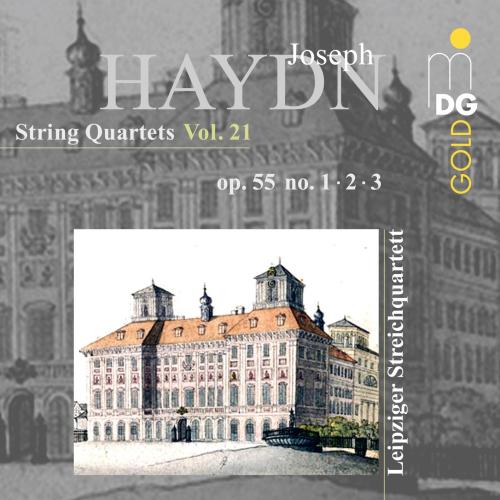
Haydn: String Quartets, Vol. 21 Leipziger Streichquartett
Album info
Album-Release:
2026
HRA-Release:
06.03.2026
Label: Musikproduktion Dabringhaus und Grimm
Genre: Classical
Subgenre: Chamber Music
Artist: Leipziger Streichquartett
Composer: Franz Joseph Haydn (1732-1809)
Album including Album cover Booklet (PDF)
- Joseph Haydn (1732 - 1809): String Quartet in A Major, Op. 55 No. 1, Hob. III: 60:
- 1 Haydn: String Quartet in A Major, Op. 55 No. 1, Hob. III: 60: I. Allegro 08:58
- 2 Haydn: String Quartet in A Major, Op. 55 No. 1, Hob. III: 60: II. Adagio cantabile 04:19
- 3 Haydn: String Quartet in A Major, Op. 55 No. 1, Hob. III: 60: III. Menuet 03:10
- 4 Haydn: String Quartet in A Major, Op. 55 No. 1, Hob. III: 60: IV. Finale. Vivace 02:46
- String Quartet in F Minor, Op. 55 No. 2, Hob. III: 61:
- 5 Haydn: String Quartet in F Minor, Op. 55 No. 2, Hob. III: 61: I. Andante o più tosto allegretto 09:52
- 6 Haydn: String Quartet in F Minor, Op. 55 No. 2, Hob. III: 61: II. Allegro 08:07
- 7 Haydn: String Quartet in F Minor, Op. 55 No. 2, Hob. III: 61: III. Menuet. Allegro 04:45
- 8 Haydn: String Quartet in F Minor, Op. 55 No. 2, Hob. III: 61: IV. Finale. Presto 05:18
- String Quartet in B-Flat Major, Op. 55 No. 3, Hob. III: 62:
- 9 Haydn: String Quartet in B-Flat Major, Op. 55 No. 3, Hob. III: 62: I. Vivace assai 07:14
- 10 Haydn: String Quartet in B-Flat Major, Op. 55 No. 3, Hob. III: 62: II. Adagio ma non troppo 05:45
- 11 Haydn: String Quartet in B-Flat Major, Op. 55 No. 3, Hob. III: 62: III. Menuet 04:10
- 12 Haydn: String Quartet in B-Flat Major, Op. 55 No. 3, Hob. III: 62: IV. Finale. Presto 04:39
Info for Haydn: String Quartets, Vol. 21
With the three quartets of Op. 55, the Leipzig String Quartet brings Haydn's mature genius vividly to life. These works capture the composer at the peak of the Classical era, blending elegance, wit, and profound musical insight. In the Quartet’s hands, every nuance and flourish shines, offering listeners an unforgettable journey through Haydn's timeless artistry.
No. 1 radiates brilliance from its opening energetic theme, with flowing figures, virtuosic triplets, and a characteristically unexpected modulation that sets the tone for the work. Haydn’s inventiveness shines throughout, from the noble and finely scored Adagio cantabile to the Minuet, Trio, and lively Finale, which feature imaginative instrumental interplay, subtle formal extensions, and a confident return to the tonic.
According to legend, Haydn traded "his best quartet" in exchange for English razors, giving No. 2 its nickname. Remarkably it opens with a slow, expressive variation movement in F minor. The alternation between minor and major creates a tonal limbo that creates a sense of tonal instability. This tension is sharpened in the spiky Allegro and contemplative Minuet, before an exuberant, jig-like finale decisively affirms a triumphant F major.
No. 3 opens with striking simplicity, as a unison motif of descending seconds gives way to sighing figures and a more animated second subject, all of which Haydn masterfully develops through concise modulation, counterpoint, and fugato. His inventiveness continues with a questioning-and-answering Adagio permeated by variation, a Minuet whose final gesture seeds the Trio, and a virtuosic Presto finale that drives the quartet to a brisk and decisive conclusion."
Leipziger Streichquartet

The Leipzig Quartet
has become one of the most sought-after and versatile ensembles of this genre in the 35 years of its existence. Founded in 1988, three of its members were active in the Leipzig Gewandhaus Orchestra until they left the orchestra in 1993 upon completing intensive studies with Gerhard Bosse and Karl Suske in Leipzig, the Amadeus Quartet in London and Cologne, Hatto Beyerle in Hanover and Walter Levin in Lübeck. From then on, they devoted themselves exclusively to the art of chamber music.
Since then, the ensemble has received numerous international honors and awards. In 1991, they won the prestigious international ARD competition in Munich and the Brüder Busch Prize. The following year the ensemble was awarded the Siemens Music Prize, and also received a scholarship from the Amadeus Scholarship Fund and the Stiftung Kulturfonds.
For more than 25 years, the ensemble arranged its own concert series “Pro Quatuor” in Leipzig. In addition, they are regularly invited to perform at renowned festivals in over 40 European countries, as well as in the United States and South America, Australia, Japan, Israel, Africa and Asia. The ensemble keeps an active concert schedule.
Longstanding collaborations with musical partners have enriched the ensemble’s repertoire over many years. These collaborations include clarinetist Karl Leister, cellist Michael Sanderling, violists Barbara Buntrock and Hartmut Rohde, pianists Alfred Brendel, Menahem Pressler, Andreas Staier and Christian Zacharias, sopranos Juliane Banse and Christiane Oelze, baritone Olaf Bär as well as the “King of Klezmer”, Giora Feidman.
Since 1992, the ensemble records its extensive repertoire on CD exclusively for the company Musikproduktion Dabringhaus und Grimm. These include complete recordings of works by Ludwig van Beethoven, Johannes Brahms, Felix Mendelssohn Bartholdy, Wolfgang Amadeus Mozart and the entire Second Viennese School.
To date, the ensemble has released around 100 recordings, which are highly acclaimed by international critics and have received numerous awards, such as the Diapason d‘Or, the Premios CD-Compact, the Indie Award and five ECHO-Klassik Prizes.
Currently, the ensemble is devoting itself to the string quartet oeuvre of Joachim Raff as well as to the complete recording of Haydn‘s string quartets, which is due to be completed in 2024.
Another important focus has always been the work with contemporary composers – this has resulted in numerous world premieres of works by Beat Furrer, Jörg Widmann, Wolfgang Rihm, Steffen Schleiermacher, Christian Ofenbauer, Siegfried Thiele, Bernd Franke, Cristóbal Halffter and many others. Last year, the ensemble performed Thomas Agerfeldt Olsen‘s “Plappergeister” at the WDR Funkhauskonzert in Cologne.
Invited by Claudio Abbado, the LSQ served as a member of the Lucerne Festival Orchestra for ten years and held a fellowship at Tokyo University of the Art (Geidai) for many years.
Booklet for Haydn: String Quartets, Vol. 21