


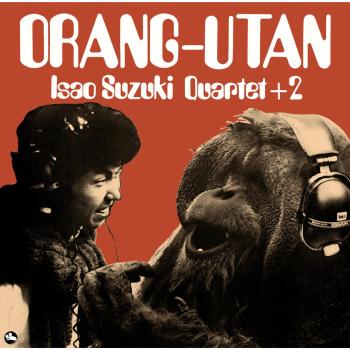
Isao Suzuki Quartet +2
Biography Isao Suzuki Quartet +2
Isao Suzuki
was born on January 2, 1933, in Tokyo. He attended a Louis Armstrong All Stars concert in December 1953, an experience that shaped his decision to pursue jazz. In 1956, Suzuki began his professional career playing double bass on United States military bases in Tokyo. He developed foundational skills in bebop while performing with prominent Japanese musicians including Sadao Watanabe, Hidehiko Matsumoto, and Shotaro Moriyasu. From 1965 to 1969, Suzuki led his own ensemble and consolidated his position as a bandleader within Tokyo’s developing jazz scene. Suzuki moved to New York City in 1969 and spent two transformative years immersed in the jazz circuit. He recorded and performed as a sideman with Charles Mingus, Thelonious Monk, Ella Fitzgerald, Ron Carter, Jim Hall, and Paul Desmond. Suzuki also spent approximately one year with Art Blakey’s Jazz Messengers, an experience he credited as formative to his understanding of jazz discipline. He returned to Japan in 1971 after Art Blakey’s arrest at a Canadian airport ended the engagement. Upon returning to Japan, Suzuki became a catalyzing force in Japanese jazz and signed with Three Blind Mice Records. His breakthrough album “Blow Up” (1973) featured drummer George Otsuka, pianist Kunihiko Sugano, and bassist Takashi Mizuhashi. The album won the Jazz of Japan Award and Swing Journal’s Jazz Disc Award. Suzuki showcased distinctive mastery of both double bass and cello, employing pizzicato lines and unconventional techniques including scratched cello and found percussion on tracks such as “Aqua Marine.” This established Three Blind Mice’s audiophile engineering standard and became a cornerstone of Japanese modern jazz. During the 1970s, he led a prolific recording career across multiple labels, releasing over 47 albums that decade. Key albums included “Blue City” (1974) with pianist Kunihiko Sugano and guitarist Kazumi Watanabe, and “Black Orpheus” (1976), a trio with pianist Tsuyoshi Yamamoto. Suzuki’s later work demonstrated remarkable stylistic range and instrumental mastery. He expanded his palette to include piccolo bass and continued leading ensembles while collaborating with international artists. His 1986 album “Approach” featured percussionist Masahiko Togashi, keyboardist Hideo Ichikawa, and guitarist Akira Shiomoto. On “Self-Portrait” (1980), Suzuki performed on over 20 instruments, underscoring his versatility across diverse jazz contexts. He opened a jazz club in Osaka in 1987. Suzuki received the Fumio Nanri Prize in 2008 in recognition of his contributions to Japanese jazz. He died on March 8, 2022, in Kawasaki at age 89 from COVID-19.