



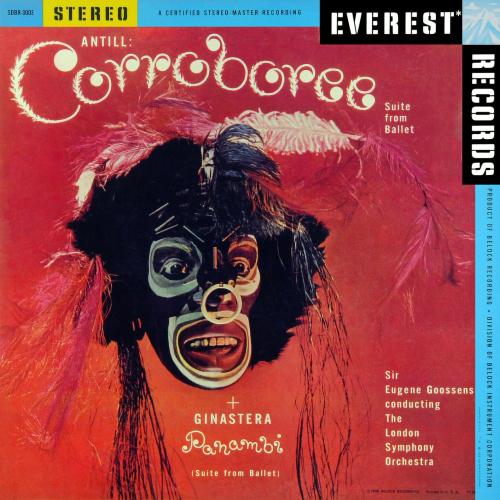
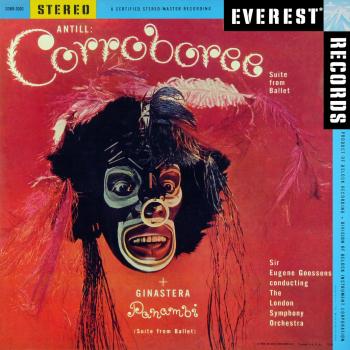
Antill: Corroboree - Ginastera: Panambi (Transferred From The Original Everest Records Master Tapes) London Symphony Orchestra & Sir Eugene Goossens
Album Info
Album Veröffentlichung:
2013
HRA-Veröffentlichung:
14.01.2026
Label: Everest
Genre: Classical
Subgenre: Orchestral
Interpret: London Symphony Orchestra & Sir Eugene Goossens
Komponist: John Antill (1904-1986), Alberto Ginastera (1916-1983)
Das Album enthält Albumcover Booklet (PDF)
Entschuldigen Sie bitte!
Sehr geehrter HIGHRESAUDIO Besucher,
leider kann das Album zurzeit aufgrund von Länder- und Lizenzbeschränkungen nicht gekauft werden oder uns liegt der offizielle Veröffentlichungstermin für Ihr Land noch nicht vor. Wir aktualisieren unsere Veröffentlichungstermine ein- bis zweimal die Woche. Bitte schauen Sie ab und zu mal wieder rein.
Wir empfehlen Ihnen das Album auf Ihre Merkliste zu setzen.
Wir bedanken uns für Ihr Verständnis und Ihre Geduld.
Ihr, HIGHRESAUDIO
- John Antill (1904 - 1986): Corroboree, Suite from the Ballet:
- 1 Antill: Corroboree, Suite from the Ballet: I. Welcome Ceremony (Remastered 2013) 02:55
- 2 Antill: Corroboree, Suite from the Ballet: II. Dance to the Evening Star (Remastered 2013) 08:52
- 3 Antill: Corroboree, Suite from the Ballet: III. A Rain Dance (Remastered 2013) 02:35
- 4 Antill: Corroboree, Suite from the Ballet: IV. Procession of the Totems (Remastered 2013) 02:25
- 5 Antill: Corroboree, Suite from the Ballet: V. Closing Fire Ceremony (Remastered 2013) 07:53
- Alberto Ginastera (1916 - 1983): Panambi, Ballet Suite: I
- 6 Ginastera: Panambi, Ballet Suite: I. Moonlight on the Parana (Remastered 2012) 05:35
- 7 Ginastera: Panambi, Ballet Suite: II. Invocation of the Powerful Spirits (Remastered 2012) 01:12
- 8 Ginastera: Panambi, Ballet Suite: III. Lament of the Maidens and Rondo of the Maidens (Remastered 2012) 02:29
- 9 Ginastera: Panambi, Ballet Suite: IV. Dance of the Warriors (Remastered 2012) 03:23
Info zu Antill: Corroboree - Ginastera: Panambi (Transferred From The Original Everest Records Master Tapes)
1947 führte Sir Eugene Goosens diese Komposition, die den als „Corroboree” bekannten Tanz der australischen Aborigines dokumentiert, erstmals auf. 1960 nahmen Goosens und das London Symphony Orchestra für Everest diese großartige – möglicherweise die beste jemals aufgenommene – Aufführung von Corroboree auf, die sogar noch besser ist als die berühmte EMI-Aufnahme desselben Stücks aus dem Jahr 1977.
Das originale 3-Spur-Halbzollband hat alles mit einer selten erreichten Definition und Klarheit eingefangen. Diese Aufnahme stammt natürlich von einem Quellband, das etwas vom Originalband entfernt ist, aber die Klarheit dieser Übertragung lässt vermuten, dass sie nicht weit von dem Stereo-Edit-Master entfernt ist, der aus dem Original gemischt wurde. Bob äußert sich dazu nicht. Ich empfehle Ihnen, sich dieses Album zu besorgen und es selbst anzuhören. Wenn Sie stolz auf Ihr Audiosystem sind, wird diese Aufnahme es auf eine harte Probe stellen. Außerdem ist die Musik großartig.
"Gerade die zahlreichen symphonischen Dichtungen und Balletmusiken des 20. Jahrhunderts haben es den Reissue-Produzenten angetan, wurde das damals noch junge Medium Schallplatte doch durch die oft sehr lautmalerischen Werke bis an seine Grenzen ausgelotet – auch heute noch klanglich spannend, musikalisch dagegen oft zweitrangig. Eine löbliche Ausnahme bildet das Hauptwerk des vorliegenden Albums: „Corroboree“ von John Antill basiert auf einem uralten Musik- und Tanzritual der Aboriginees, dem der Komponist als Junge beiwohnen durfte. Antill ist bei der Umsetzung deutlich weiter gegangen als die meisten anderen seiner Zeitgenossen, die sich herkömmlicher orchestraler Mittel bedienten. Besonders die Perkussionisten haben bei Corroboree zu tun, steigert sich das Werk vom meditativen Beginn doch in eine völlig chaotische Extase, die dem Orchester alle Register abverlangt. Die für unsere Ohren doch recht fremdartigen Harmonien hat Antill in ein schlüssiges und spannendes Orchesterwerk umgesetzt, das das ursprünglich siebenszenige Ballett auf vier Sätze zusammenzieht. Eugene Goossens hat sein London Symphony Orchestra gut im Griff, vor allem die scheinbar völlig chaotischen Passagen gelingen paradoxerweise durch die volle Kontrolle des Dirigenten dynamisch und beeindruckend." (HiFiTest.de)
London Symphony Orchestra
Sir Eugene Goossens, Dirigent
Digitally remastered
Eugene Goossens/strong>
was born into a family of musicians: his grandfather (who moved to Britain from Belgium in 1873) and father, both called Eugene, were prominent conductors, mainly of opera; Eugene’s brother Leon was one of the most distinguished oboists of the twentieth century, his sisters Marie and Sidonie were harpists, and another brother, Adolph, who was killed in the First World War, played the horn.
Eugene Goossens (III) was born in London on 26 May 1893, though the family home was in Liverpool. At the age of eight he was sent to boarding school in Bruges, and at ten he began to study music in the Conservatory there, as his grandfather had done; from the age of thirteen he attended the Liverpool College of Music. In 1907 he went to the Royal College of Music in London, studying violin and, from 1910, composition, with Sir Charles Villiers Stanford and with Charles Wood.
He had begun to conduct as a student, and in 1913 he conducted one of Sir Henry Wood’s Promenade Concerts at the Queen’s Hall. Initially, though, he earned his living as a violinist, playing in several string quartets. In January 1916 (a heart condition having saved him from war service) he stood in for Beecham at the first performances of Stanford’s opera The Critic, and thus began a fruitful relationship with Beecham as protégé and deputy.
In 1921 he established an orchestra for five concerts of modern music, one of which (7 June 1921) included the first UK performance of The Rite of Spring, in the presence of Stravinsky, Diaghilev and Massine. Diaghilev responded by engaging Goossens to conduct the Ballets Russes. In 1923 Goossens was appointed conductor of the Rochester Philharmonic in upstate New York, and in 1931 he became conductor of the Cincinnati Symphony Orchestra, remaining there until 1946. The next year he took up the position of director of the New South Wales Conservatory of Music, a post he held until 1956, by which time he was also chief conductor of the Sydney Symphony Orchestra. He was knighted in 1955. He resigned his posts in 1956 and spent the rest of his career working free-lance until his death on 13 June 1962.
Although Goossens’ first compositions were small-scale – piano pieces, songs, chamber music – he was writing confidently for orchestra from early on, producing the Variations on a Chinese Theme (1911), Miniature Fantasy for strings (1911), Perseus, a symphonic poem (1914), and Ossian, a symphonic prelude (1915). At this stage his music generally shows the influence of the French school, Debussy in particular. His First Symphony was completed in 1940, in Cincincatti, and the Second Symphony was premiered in 1946. Goossens composed two operas, Judith (1925) and Don Juan de Mañara (1934), a massive oratorio, Apocalypse (1951), and a generous quantity of other works, orchestral, chamber, instrumental. His music was lost from sight for some years after his death but began to re-emerge from the mid-1990s with recordings from the Australian Broadcasting Corporation.
Booklet für Antill: Corroboree - Ginastera: Panambi (Transferred From The Original Everest Records Master Tapes)