





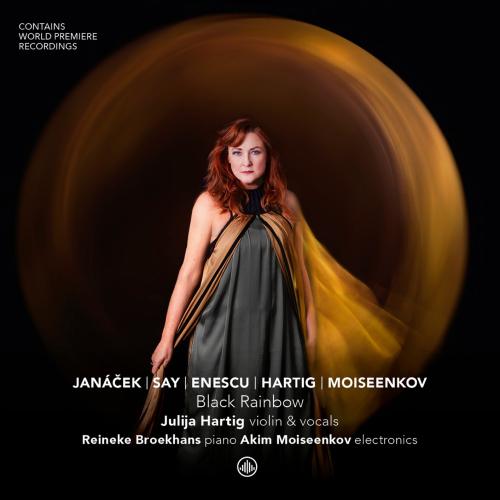
Black Rainbow Julija Hartig & Reineke Broekhans
Album Info
Album Veröffentlichung:
2026
HRA-Veröffentlichung:
16.01.2026
Label: Challenge Classics
Genre: Classical
Subgenre: Instrumental
Interpret: Julija Hartig & Reineke Broekhans
Komponist: Leoš Janáček (1854-1928), Fazıl Say (1970), George Enescu (1881-1955), Akim Moiseenkov (1959)
Das Album enthält Albumcover Booklet (PDF)
- Lurking Afar: Sonata for violin and piano:
- 1 Janáček: Sonata for violin and piano: I. Con moto 05:43
- 2 Janáček: Sonata for violin and piano: II. Ballada 05:51
- 3 Janáček: Sonata for violin and piano: III. Allegretto 02:36
- 4 Janáček: Sonata for violin and piano: IV. Adagio 05:14
- Fazil Say (b. 1970): Violin and piano Sonata No. 1, Op. 7:
- 5 Say: Violin and piano Sonata No. 1, Op. 7: I. Melancholy - Andante Mysterioso 03:42
- 6 Say: Violin and piano Sonata No. 1, Op. 7: II. Grotesque - Moderato Scherzando 02:18
- 7 Say: Violin and piano Sonata No. 1, Op. 7: III. Perpetuum mobile - Presto 01:57
- 8 Say: Violin and piano Sonata No. 1, Op. 7: IV. Anonymus - Andante 04:07
- 9 Say: Violin and piano Sonata No. 1, Op. 7: V. Melancholy (Da Capo) - Andante Mysterioso 04:20
- George Enescu (1881 - 1955): Violin and piano Sonata No. 3 in A Minor, Op. 25, dans le caractère populaire roumain:
- 10 Enescu: Violin and piano Sonata No. 3 in A Minor, Op. 25, dans le caractère populaire roumain: I. Moderato malinconico 09:46
- 11 Enescu: Violin and piano Sonata No. 3 in A Minor, Op. 25, dans le caractère populaire roumain: II. Andante sostenuto e misterioso 09:11
- 12 Enescu: Violin and piano Sonata No. 3 in A Minor, Op. 25, dans le caractère populaire roumain: III. Allegro con brio, ma non troppo mosso 08:34
- Akim Moiseenkov (b. 1987), Julija Hartig (b. 1972): Black Rainbow - Quo Vadis Homini for violin, voice and live electronics:
- 13 Moiseenkov, Hartig: Black Rainbow - Quo Vadis Homini for violin, voice and live electronics 14:58
- Rain:
- 14 Moiseenkov, Hartig: Rain 01:34
Info zu Black Rainbow
Your new album "Black Rainbow" features works by Janáček, Enescu, Fazıl Say, as well as your own composition created in collaboration with Akim Moiseenkov. How did you approach preparing and shaping interpretations of such diverse styles – from the Czech folk inspiration in Janáček, through the Romanian-Balkan colors in Enescu, to the contemporary sound of Fazıl Say?
The repertoire on this album is, in fact, my musical and cultural DNA. The music heard in these works exists within me; I recognize it both as the sounds of my childhood and as a deeply rooted system of recognition and belonging. My family heritage is so complex and rich that I believe I can hear in Janáček’s music the words, songs, and especially the palette of emotions that feel like an inheritance from a grandmother or great-grandmother.
The Balkan mystical folklore that, for example, permeates Enescu’s sonata is entirely based on a super-folkloric style that has always fascinated me. It is music that awakens in me the deepest sense of freedom and a marvelous greed for life! This sonata is rarely performed because it is extremely complex and demands great effort from the performer to make the interpretation sound like a spontaneous improvisation of folk songs. Moreover, the musical language of this sonata cannot be simply learned – it must be lived. When I knew this sonata would hold a central place on the new album, I did not yet know that my great-great-great-great-grandmother was born and raised in a town in Bukovina, only an hour away from the village where Enescu was born – and just a few years before him. Coincidence?
Fazıl Say’s sonata is exciting in a similar way, as it fits into an idiom inspired by folk motifs. However, he, as an exceptional artist, is also an inspiration to me because he stands as a symbol of a higher purpose – musical activism – which is something that currently intrigues me greatly.
„The music heard in these works lives within me; I recognize it both as the sounds of my childhood and as a deeply rooted system of recognition and belonging.“ (Julija Hartig)
Julija Hartig, violin
Reineke Broekhans, piano
Julija Hartig
The repertoire of Edison winner Julija Hartig includes pieces from baroque to contemporary music. Her interpretations are characterized by great expressivity and temperament, refined technique, and a warm sensitivity to colour. Her exciting way of playing often led to mutually inspiring collaborations with contemporary composers. Several pieces have been written for and premiered by her. In 2022 as a result of this wonderful phenomenon a CD ‘D a r k V e l v e t’ an autobiography in music was released on the label Challenge Classics. In October 2023 Julija won an Edison Klasiek in the category Newcomers National with her debut album Dark Velvet. Her artistic curiosity led her to a new height of co-composing a piece Black Rainbow ( Commissioned by the Nederlandse Vioolconcoursen for the Night of the Violin 2025) in collaboration with artist Akim Moiseenkov.
Born to a family of musicians, Julija started her first violin lessons at the age of five. As a young talent, she won prizes such as the Festival of Music Schools of Serbia and the Competition of Young Interpreters of Yugoslavia.
After finishing her studies of violin at the Academy of Arts in Novi Sad (Yugoslavia), she was engaged as an assistant professor in the class of her former teacher Evgenia Tchugaeva at the same conservatory.
Since 1994, Julija lives in The Netherlands, where she studied at the Conservatory of Rotterdam with Professor Ilya Grubert and the Conservatory of Utrecht with Professor Keiko Wataya where she graduated with Cum Laude.
As a soloist, she performed with various orchestras such as The Symphony Orchestra of the Academy of Arts in Novi Sad (Yugoslavia), Chamber Orchestra “Camerata Academica” Novi Sad, Belgrade Strings, St Georges Strings, Radio Symphony Orchestra of Serbia, Brabants Kamer Orkest, The Netherlands Radio Chamber Philharmonic. She has given recitals and chamber music concerts in Yugoslavia, Russia, The Netherlands, Germany, Belgium, Finland, Australia, and Brazil.
She participated in international festivals such as BEMUS in Belgrade, The Summer Festival in Dubrovnik, Barka Festival of Music from formal Yugoslavia in Amsterdam, The Grachten Festival in Amsterdam, November Music in ‘s-Hertogenbosch, En Plein Public in Breda, Peter de Grote Festival in Groningen, Beethovenfest in Bonn, Festival MiTo - Italy, Ojai Music Festival in USA, International Chamber music festival Joao Pessoa - Brazil.
“Operator” by Florian Maier, written for The Dutch Radio Chamber Philharmonic and violin soloist Julija Hartig, conducted by Micha Hamel on the Dutch Music Days 2009 in October in the Muziekgebouw aan't IJ, Amsterdam, won a recommendation for worldwide broadcast by more than 30 radio stations in Unesco's 2010 Rostrum of Composers.
She recorded for CD labels in the Netherlands and Yugoslavia. In 2010 RTS (Radio Television Serbia) issued 4 CDs of complete works by Ljubica Maric, a composer and artist with whom she had a very close connection, with all the solo violin and chamber music repertoire written by this composer being performed by her.
With pianist Reineke Broekhans, she formed a Duo Hartig-Broekhans which won a prize at an International Chamber Music Competition “Gaetano Zinetti” in 2004.
Since 2003 she has been a member of the virtuoso ensemble The Hungry Gods. With this unique ensemble, she has been active in interdisciplinary projects such as film and theatre.
ROctet, the only string octet in The Netherlands, is another ensemble Julija is a member since 2016. She is also one of the business managers of this ensemble.
Julija is one of the founding members of Splendor Amsterdam, a new creative podium in Amsterdam - winner of the Amsterdam Cultural Prize in 2015. She is also one of the initiators of the LUDWIG collective that won the GRAMMY award with their first CD with Barbara Hannigan in 2018.
Julija Hartig plays a Jean-Baptiste Vuillaume violin (“Ex-Zimmermann”), that is part of the Dutch National Musical Instrument Foundation in the Netherlands.
Booklet für Black Rainbow