






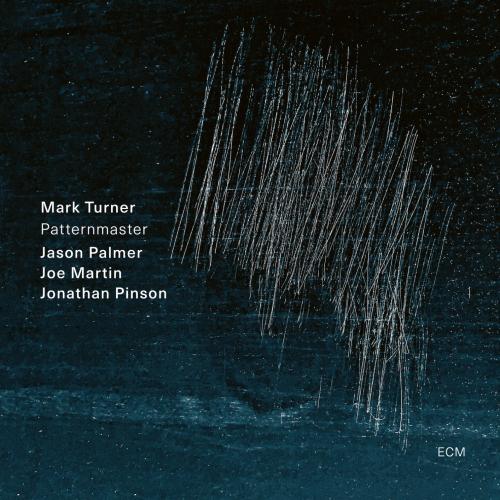
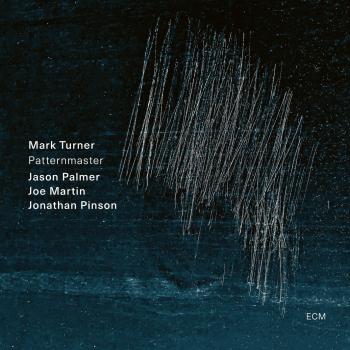
Patternmaster Mark Turner, Jason Palmer, Joe Martin, Jonathan Pinson
Album info
Album-Release:
2026
HRA-Release:
13.03.2026
Label: ECM Records
Genre: Jazz
Subgenre: Contemporary Jazz
Artist: Mark Turner, Jason Palmer, Joe Martin, Jonathan Pinson
Album including Album cover Booklet (PDF)
I`m sorry!
Dear HIGHRESAUDIO Visitor,
due to territorial constraints and also different releases dates in each country you currently can`t purchase this album. We are updating our release dates twice a week. So, please feel free to check from time-to-time, if the album is available for your country.
We suggest, that you bookmark the album and use our Short List function.
Thank you for your understanding and patience.
Yours sincerely, HIGHRESAUDIO
- 1 Patternmaster 06:02
- 2 Trece Ocho 09:55
- 3 It Very Well May Be 06:24
- 4 Lehman's Lair 06:09
- 5 The Happiest Man on Earth 07:38
- 6 Supersister 12:15
Info for Patternmaster
Patternmaster captures Mark Turner’s quartet at its most adventurous, sophisticated and hard-hitting. In his review of the West Coast-based saxophonist’s last quartet effort for ECM, 2022’s Return From The Stars, the Swiss daily Weltwoche’s Peter Rüedi spoke of “the leanest, most concentrated, and most inspired improvised chamber music imaginable.” It’s a fitting description of the tenor saxophonist’s powerful quartet endeavours which have reached a new creative peak on this new record. Both boundless improvisation and cool control are driving motors behind a group that has moulded its common musical understanding over years on the road and in the studio.
“The more you trust, the more chances you can take and the deeper you can go with people,” notes Mark, whose confidence in his quartet colleagues Jason Palmer on trumpet, bassist Joe Martin and Jonathan Pinson on drums continues to deepen with every new tour, session and release. “And beyond craft, you can gage into the art of music more in depth. And you feel free to experiment more compositionally, without ever having to worry about what’s going to happen because you know it’s going to turn out great.”
One word Mark repeats particularly often when speaking of the chemistry in his group or between other master musicians is “psycho-spirituality”, referring to a higher capacity of intuition. It also comes up when talking about the sci-fi novel that gives the album and title track their names – a trick he already used for Return From The Stars. The first published (1976) yet chronologically last book of the “Patternist” series by American author Octavia E. Butler, “Patternmaster” deals with a distant future, where humans have been divided into the dominant Patternists, the "diseased" and animalistic Clayarks, and the enslaved human mutes. The Patternists, bred for intelligence and psionic abilities, are networked telepaths, much like in a hive-mind. They are ruled by the most powerful telepath, known as the Patternmaster.
“Wayne Shorter was also kind of a ‘Patternmaster’ if you ask me, “ says Mark, who wrote the title track around the same time Wayne Shorter passed away. “He was also an avid sci-fi fan and I named the tune after him in a way. I think some musicians or artists, when they reach a high level, you could say they have psionic abilities. Abilities beyond conventional measure.” The song is also a contrafact on Shorter’s “Pinocchio”, originally recorded with Miles Davis’s second quintet in 1967’s Nefertiti session. “But I masked the contrafact pretty well” (Mark laughs).
Turner and Palmer blow themes with expansive harmonic implications on top of Joe and Jonathan, players who intersect with the horns on a melodic, harmonic and rhythmic level with great intensity. The ten-minute long slow burn of “Trece Ocho” sounds like a sister-composition to the title track off Return From The Stars, the theme stretched, slightly shrouded and deformed to fit fiery blowing on sax and trumpet. The alchemy that exists between Turner and Palmer is unmistakably rare and to the fore throughout the album.
Mark: “Whatever it is that Jason and I have, I definitely want to stay with it. We have a connection. And there are things that Jason has that I need in my playing. I like to play with people that are better than I am at certain things. I also think both of us are people who tend to work hard on music – a certain amount of fire and discipline. I saw that about him from the beginning.”
They share intense trade-offs on the upbeat “Lehman’s Lair”, named after Mark’s frequent collaborator and saxophone colleague Steve Lehman. It’s inspired by one of his songs, though “ironically his tune has complex harmonies and a difficult melody, whereas mine now has semi-complex harmony but a simple, very singable melody”.
“The Happiest Man On Earth” too has an immediate relative on the group’s last recording for ECM, sharing many motifs and the overall rhythmic downtempo in common with “Lincoln Heights”. It demonstrates Mark’s proclivity to stick with a thing, think it over repeatedly and repurpose, if found worth reconsidering – and in this instance it proves more than worth it.
“Supersister” is emblematic of this tendency, the song having previously appeared in a more minimalist iteration on Mark’s Fly Trio recording Sky & Country from 2009. It’s a late highlight here, with the quartet both at its most lyrically direct but also most outgoing. Pinson kicks things off with an uncompromising “drum and bass” drum part that pulls through the piece with insatiable energy. “I wanted to have a tune on this record that has multiple sections – I just don’t hear that very much in this kind of format. Long compositions with complex harmony and different parts. And I always felt like I wanted to have a bit more harmony in this tune. Writing it I realized I had to change the key – it was too low for the trumpet. It’s up a major third and there’s a key change in it, where it goes back to the original key for the bass solo. Weaving these parts together created another section and changed the composition for the better.”
For the high-intensity swing of “It Very Well May Be” Joe Martin eloquently takes several extensive solo bars with Pinson’s sweeping cymbals recalling a more traditional jazz era. In fact, there’s a timeless quality that inhabits these six Turner originals, one that channels the classic be-bop era and the creative vanguards that followed it while also being compellingly contemporary, perhaps anticipating the future.
Mark Turner Quartet:
Mark Turner, tenor saxophone
Jason Palmer, trumpet
Joe Martin, double bass
Jonathan Pinson, drums
Recorded April 2024, Studios La Buissonne, Pernes les Fontaines
Produced by Manfred Eicher
Mark Turner
is recognized as the premier saxophonist of his generation, having influenced an entire worldwide following of young and old saxophonists with his beautifully crafted improvisations, facile ear, graceful and effortless sound and selfless musicianship.
Born November 10, 1965 in Fairborn, Ohio, and raised in Southern California, Turner originally intended to become a commercial artist. In elementary school he played the clarinet, followed by the alto sax and then the tenor in high school. He graduated from Berklee College of Music in 1990 before moving to New York.
Mark Turner’s sound is remniscent of that of Warne Marsh, in that he often produces a somewhat dry, woody tone. He also has elements of John Coltrane in his playing. Turner has mentioned both Marsh and Coltrane as influences, and has used elements of both players’ styles in his music without resorting to mimicry. Turner’s range extends effortlessly up into the high altissimo register, and he makes use of the full range of his instrument in his improvisations. His improvised lines tend to be harmonically and rythmically complex, but with a constant organic flow. His compositions often make use of repeated patterns, odd-metered time signatures, intervallic leaps, and also a selective use of space.
Mark Turner frequently collaborates with Kurt Rosenwinkel, Larry Grenadier, and Jeff Ballard, and has formed various collectives that include these musicians (M.T.B. and prominently, Fly). He has performed with the who’s who of international jazz talent, ranging from Lee Konitz to the San Francisco Jazz Collective.
Booklet for Patternmaster