
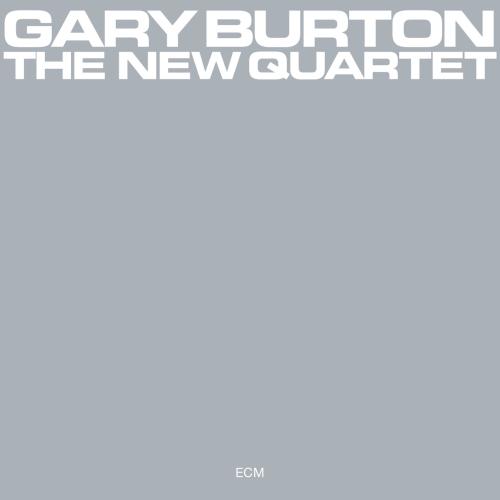
The New Quartet (Remastered) Gary Burton, Mick Goodrick, Abraham Laboriel, Harry Blazer
Album info
Album-Release:
1973
HRA-Release:
30.01.2026
Label: ECM Records
Genre: Jazz
Subgenre: Contemporary Jazz
Artist: Gary Burton, Mick Goodrick, Abraham Laboriel, Harry Blazer
Album including Album cover
I`m sorry!
Dear HIGHRESAUDIO Visitor,
due to territorial constraints and also different releases dates in each country you currently can`t purchase this album. We are updating our release dates twice a week. So, please feel free to check from time-to-time, if the album is available for your country.
We suggest, that you bookmark the album and use our Short List function.
Thank you for your understanding and patience.
Yours sincerely, HIGHRESAUDIO
- 1 Open Your Eyes, You Can Fly 06:38
- 2 Coral 04:08
- 3 Tying Up Loose Ends 05:09
- 4 Brownout 06:31
- 5 Olhos De Gato 05:36
- 6 Mallet Man 07:09
- 7 Four Or Less 06:08
- 8 Nonsequence 04:30
Info for The New Quartet (Remastered)
As well as being the great vibraphone innovator of the era, Gary Burton is known for his unparalleled intuition as a talent scout. In 1973, The New Quartet introduced Abraham Laboriel: this was the first recording of the bassist who would soon become one of the most in-demand session players across all genres. “It must be emphasised that Laboriel sounds like a major artist in the making with his astonishing bass work,” wrote Melody Maker.
Guitarist Mick Goodrick also emerged as a player to watch on this album, shining in a well-conceived programme with compositions of Keith Jarrett, Chick Corea, Carla Bley, Mike Gibbs and bandleader Burton.
One needs only to catch the first few licks of “Open Your Eyes, You Can Fly” to know this album represents an era that can never be recaptured. Burton does wonders with the Chick Corea tune, lifting its upbeat soul to the greatest heights of creative pleasure. One can almost taste the freshness of his sound, the sheer newness of vision and synergy of musicianship ingrained into every moment of this phenomenal record. This was another early disc that managed to fall under my radar until I sought to review it. Burton is always a supreme joy to listen to, and with this, his second ECM appearance, he certainly made a profound statement. Burton himself contributes one composition, the enchanting “Brownout,” which takes full advantage of the rhythmic precision of his backing trio for a deft volley of restraint and abandon. Two Gordon Beck tunes provide the most robust flavors in this thickening stew, balancing the smooth full-ensemble nosh of “Tying Up Loose Ends” with the infectious full course of blistering key changes and nimble flair that is “Mallet Man,” the album’s centerpiece. The ballads are haunting and moody. “Coral” (Keith Jarrett) proves just how soulful vibes can be, while “Olhos De Gato” (Carla Bley), with its seedy undercurrent and humid climate, slinks like its namesake, stalking the edges of the night. Two Mike Gibbs tunes, “Four Or Less” and “Nonsequence,” round out the set on a more playful note, making dramatic use of pauses and a wider variety of textures.
Gary Burton is synonymous with the vibes. And while I had long been one of countless admirers of his technical and melodic acuity, this album was nothing short of a revelation for me. The technique is flawless all around and glistens with Burton’s Midas touch. He contacts his instrument like fingers walking up a spine, never missing a single nerve along the way. Yet one cannot commend this album without also praising Goodrick’s phenomenal guitar work, Laboriel’s quick-witted ornaments, Blazer’s unrelenting dedication to the moment, and the astounding unity the ensemble as a whole manages to uphold. The overall balance comes across as joyously democratic, and all with a fresh-off-the-boat sound that surprises at every turn. There isn’t a single errant note, gesture, or idea to be found on The New Quartet. From start to finish, an inimitable achievement.
Gary Burton, vibraphone
Michael Goodrick, guitar
Abraham Laboriel, bass
Harry Blazer, drums
Digitally remastered
Gary Burton
Born in 1943 and raised in Indiana, Gary Burton taught himself to play the vibraphone, developing a unique approach that set a new standard for four-mallet playing. At the age of 17, he made his recording debut in Nashville, Tennessee, with guitarists Hank Garland and Chet Atkins. Two years later, Burton left his studies at Berklee College of Music to join George Shearing and subsequently Stan Getz, with whom he worked from 1964-1966.
As a member of Getz’s quartet, Burton won Down Beat magazine’s Talent Deserving of Wider Recognition award in 1965. By the time he left Getz to form his own quartet in 1967, Burton had also recorded three albums under his name for RCA. Borrowing rhythms and sonorities from rock music, while maintaining jazz’s emphasis on improvisation and harmonic complexity, Burton’s first quartet attracted large audiences from both sides of the jazz-rock spectrum. Such albums as Duster and Lofty Fake Anagram established Burton and his band as progenitors of the jazz fusion phenomenon, and Down Beat magazine awarded Burton its Jazzman of the Year award in 1968. During his subsequent association with the ECM label (1973-1988) the Burton Quartet expanded to include the young Pat Metheny on guitar, and the band began to explore a repertoire of modern compositions.
In the 1970s, Burton also began to focus on more intimate contexts for his music. His 1971 album Alone at Last, a solo vibraphone concert recorded at the 1971 Montreux Jazz Festival, was honored with a Grammy Award. Burton also turned to the rarely heard duo format, recording with bassist Steve Swallow, guitarist Ralph Towner, and most notably with pianist Chick Corea, thus cementing a long personal and professional relationship that has garnered an additional two Grammy Awards.
Also in the 1970s, Burton began his career with Berklee College of Music in Boston. Burton began as a teacher of percussion and improvisation classes at Berklee in 1971. In 1985 he was named Dean of Curriculum. In 1989, he received an honorary doctorate of music from the college, and in 1996 he was appointed Executive Vice President.
Burton recorded for GRP records in the 1980s and ’90s. In 1990, he paired up again with his former protŽgŽ Metheny for Reunion, which landed him the top spot on Billboard magazine’s jazz chart. Burton is now recording for Concord Records. Departure (Gary Burton & Friends) was released in 1997 by Concord Records as well as Native Sense, a collaboration with Chick Corea, which garnered a Grammy Award in 1998. Also in 1997, Burton recorded his second collection of tango music, Astor Piazzolla Reunion, featuring the top tango musicians of Argentina, followed by Libertango, another collection of Piazzolla music. His 1998 Concord release, Like Minds, featuring his frequent collaborators Chick Corea, Pat Metheny, Roy Haynes, and Dave Holland, was honored with a Grammy, Burton’s fifth. Gary’s vibraphone tribute CD, For Hamp, Red, Bags and Cal, will be released in March 2001 on Concord.
This album contains no booklet.