



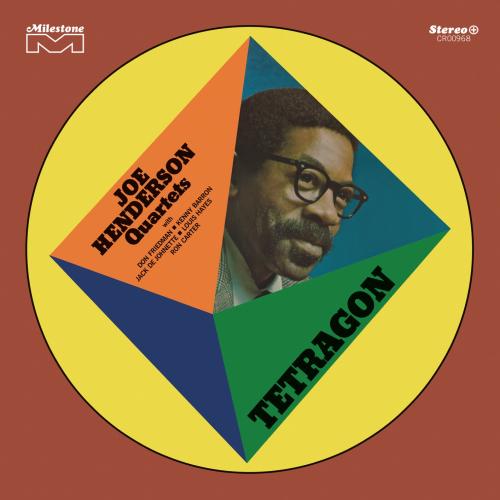
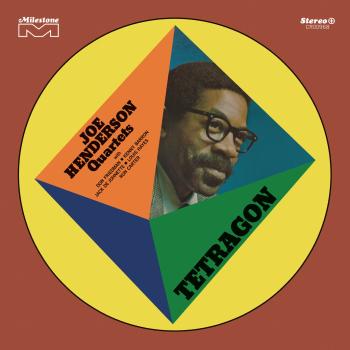
Tetragon (Remastered 2026) Joe Henderson
Album info
Album-Release:
1968
HRA-Release:
13.03.2026
Album including Album cover
I`m sorry!
Dear HIGHRESAUDIO Visitor,
due to territorial constraints and also different releases dates in each country you currently can`t purchase this album. We are updating our release dates twice a week. So, please feel free to check from time-to-time, if the album is available for your country.
We suggest, that you bookmark the album and use our Short List function.
Thank you for your understanding and patience.
Yours sincerely, HIGHRESAUDIO
- 1 Invitation (Remastered 2026) 06:14
- 2 R.J. (Remastered 2026) 05:33
- 3 The Bead Game (Remastered 2026) 08:36
- 4 Tetragon (Remastered 2026) 05:37
- 5 Waltz For Sweetie (Remastered 2026) 04:25
- 6 First Trip (Remastered 2026) 05:12
- 7 I've Got You Under My Skin (Remastered 2026) 05:03
Info for Tetragon (Remastered 2026)
Long before his general recognition in the 1990s, Joe Henderson was admired by jazz audiences and all but worshipped by saxophonists. A player whose absolute command of the horn is equaled by the fecundity of his artistic vision, Henderson emerged in the early 1960s as an independent voice. He was neither overwhelmed by John Coltrane nor attached to the Coleman Hawkins or Lester Young schools. Mistakenly described early in his career as "primarily a soul saxophonist," his stock in trade was lyricism and harmonic daring contained in a sheath of rhythmic muscle. Of his several Milestone recordings of the 1960s, Tetragon stands as a major item in the Henderson discography. His rhythm sections for the album were made up of five of the most accomplished and adventurous young players of the day.
"The combination of Kenny Barron and Louis Hayes on the other Side 2 tracks makes for a different kind of approach, but Barron like Friedman is content to play a fairly restrained role. This allows Ron Carter’s bass to become in effect almost a second lead instrument, and it’s possible to sit back and follow his unerringly graceful lines with the attention normally assigned to the work of the soloist. Such detailed listening is also due to the wonderful clarity of the all analogue remastering, cut from the original master tapes by Kevin Gray at Cohearent Audio. Well done all round: a valuable near classic has been restored to the quality it deserves." (Phil Johnson, ukjazznews.com)
Joe Henderson, tenor saxophone
Ron Carter, double bass
Don Friedman, piano (tracks 1–3 & 5)
Jack DeJohnette, drums (tracks 1–3 & 5)
Kenny Barron, piano (tracks 4, 6 & 7)
Louis Hayes, drums (tracks 4, 6 & 7)
Recorded September 27, 1967 (#4, 6–7); May 16, 1968 (#1–3, 5) at Plaza Sound Studios, New York City
Produced by Orrin Keepnews
Digitally remastered
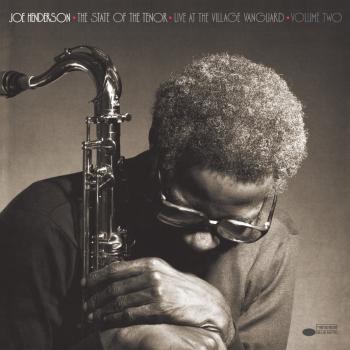

Joe Henderson
is proof that jazz can sell without watering down the music; it just takes creative marketing. Although his sound and style were virtually unchanged from the mid-'60s, Joe Henderson's signing with Verve in 1992 was treated as a major news event by the label (even though he had already recorded many memorable sessions for other companies). His Verve recordings had easy-to-market themes (tributes to Billy Strayhorn, Miles Davis, and Antonio Carlos Jobim) and, as a result, he became a national celebrity and a constant poll winner while still sounding the same as when he was in obscurity in the 1970s.
The general feeling is that it couldn't have happened to a more deserving jazz musician. After studying at Kentucky State College and Wayne State University, Joe Henderson played locally in Detroit before spending time in the military (1960-1962). He played briefly with Jack McDuff and then gained recognition for his work with Kenny Dorham (1962-1963), a veteran bop trumpeter who championed him and helped Henderson get signed to Blue Note. Henderson appeared on many Blue Note sessions both as a leader and as a sideman, spent 1964-1966 with Horace Silver's Quintet, and during 1969-1970 was in Herbie Hancock's band. From the start, he had a very distinctive sound and style which, although influenced a bit by both Sonny Rollins and John Coltrane, also contained a lot of brand new phrases and ideas. Henderson had long been able to improvise in both inside and outside settings, from hard bop to freeform. In the 1970s, he recorded frequently for Milestone and lived in San Francisco, but was somewhat taken for granted. The second half of the 1980s found him continuing his freelancing and teaching while recording for Blue Note, but it was when he hooked up with Verve that he suddenly became famous. Virtually all of his recordings are currently in print on CD, including a massive collection of his neglected (but generally rewarding) Milestone dates. On June 30, 2001, Joe Henderson passed away due to heart failure after a long battle with emphysema. (Source: Blue Note Records, Scott Yanow)
" class="ng-binding ng-scope">Joe Henderson with Chick Corea
This album contains no booklet.