
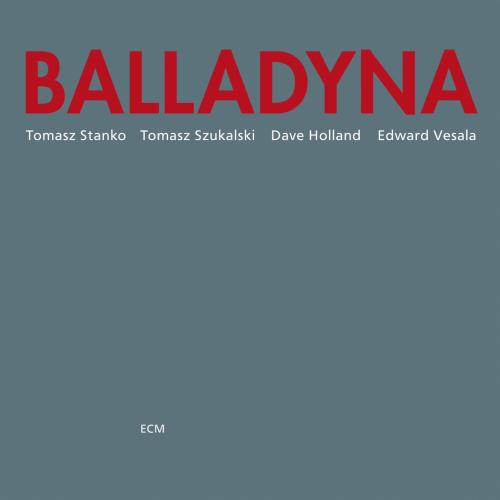
Balladyna (Remastered) Tomasz Stanko, Tomasz Szukalski, Dave Holland, Edward Vesala
Album info
Album-Release:
1976
HRA-Release:
30.01.2026
Label: ECM Records
Genre: Jazz
Subgenre: Contemporary Jazz
Artist: Tomasz Stanko, Tomasz Szukalski, Dave Holland, Edward Vesala
Album including Album cover
I`m sorry!
Dear HIGHRESAUDIO Visitor,
due to territorial constraints and also different releases dates in each country you currently can`t purchase this album. We are updating our release dates twice a week. So, please feel free to check from time-to-time, if the album is available for your country.
We suggest, that you bookmark the album and use our Short List function.
Thank you for your understanding and patience.
Yours sincerely, HIGHRESAUDIO
- 1 First Song 07:43
- 2 Tale 03:28
- 3 Num 07:11
- 4 Duet 02:55
- 5 Balladyna 07:59
- 6 Last Song 06:02
- 7 Nenaliina 05:29
Info for Balladyna (Remastered)
Stanko’s first for ECM, and a splendid introduction to the “predatory lyricism” that is the Polish trumpeter’s stylistic trademark.
I can only imagine the reactions Tomasz Stanko garnered with Balladyna, his first recording for ECM. The no-holds-barred “First Song” jumps into action with that hard swing that can only come from Dave Holland. Add to this brew the wide-ranging percussion of Edward Vesala and the spicy solos of our frontman and Tomsaz Szukalski, and you have a jambalaya to savor and remember. After such a climactic opener, Stanko could play “Happy Birthday” for all I care. Thankfully (though who knows what this quartet might have done with such ubiquity?) we a get the Ornette Coleman-infused “Tale” that faithfully charts a key transition from raw to cooked jazz. One can feel the rapt attention with which each musician listens to the other.
This live, interactive energy continues in “Num,” sustained by knitted cymbal work as the two Tomaszes go head to ecstatic head. A killer bass solo makes the cut complete. A lumbering Holland/Stanko interlude opens the door on the title number, anteing up in tutti before spreading its hand into a straight improvisatory flush. Stanko screeches above a pointillist rhythm section, Szukalski stepping into the footprints he leaves behind. A doleful, mocking tone returns in the tongue-in-cheekly titled “Last Song,” nodding like a head succumbing to sleep. The fine horn playing makes this one a standout. The actual last song, “Nenaliina,” is an effusive spring of percussion with a brassy tail. (ecmreviews.com)
Tomasz Stanko, trumpet
Tomasz Szukalski, tenor & soprano saxophones
Dave Holland, bass
Edward Vesala, drums
Digitally remastered
Tomasz Stanko
Described by the New York Times as “one of the most acclaimed improvising musicians in Europe”, Polish trumpeter Tomasz Stanko was born in 1942 and made his debut in Krakow in the late 1950s. In the 1960s he joined Krzysztof Komeda’s quintet, soon becoming its mainstay, and recorded a masterpiece of European jazz with it, the LP Astigmatic.
Though Miles Davis and Chet Baker were early influences, he was soon drawn to the free jazz of Ornette Coleman and Don Cherry. As he told jazz writer Andrew Gilbert, speaking of jazz under communism, “I was interested in artistic freedom, because in person I didn't really have a big problem living in a communist country in this time. Maybe earlier musicians had some problems, they don't have the chance to play so often, but in 1963 it was beginning to be quite all right. I was much more interested in the freedom in Ornette's music."
In the early 1970s, at the helm of the Tomasz Stanko Quintet, he came to the forefront of the free jazz scene and was featured at major European festivals. His subsequent projects reinforced this stature: Unit with Polish pianist Adam Makowicz, and a quartet co-led with Finnish drummer Edward Vesala that in 1975 attracted attention of ECM’s Manfred Eicher. Stanko’s ECM debut, Balladyna, has become a legend on both sides of the Atlantic. In the 1980s Stanko was enlisted by Cecil Taylor in several of his line-ups.
The 1990s saw a renewal of Stanko’s relationship with ECM. A new quartet, featuring pianist Bobo Stenson, bassist Anders Jormin and drummer Tony Oxley, was widely hailed as one of the best jazz groups of the decade, and the album Leosia earned a rare top rating in the Penguin Jazz Guide. Released in 1997, Litania, a tribute to the music of Krzysztof Komeda, became his first global bestseller. Subsequent ECM releases, Soul of Things and Suspended Night, featuring a young Polish quartet at the beginning of the new century brought him to the attention of US jazz fans. 2013 brought a new double album, Wisława, with a new group: Thomas Morgan (bass), Gerald Cleaver (drums) and David Virelles (piano). Jazz Journal’’s Michael Tucker hailed “essential music from one of Europe's most striking – and affecting – poets of his instrument”.
This album contains no booklet.