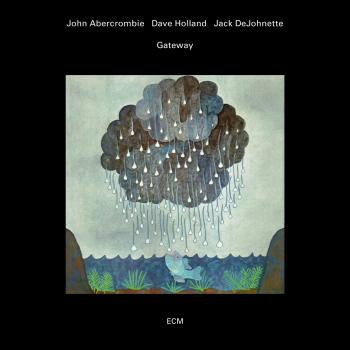
John Abercrombie, Dave Holland, Jack DeJohnette
Biography John Abercrombie, Dave Holland, Jack DeJohnette
John Abercrombie
has played on more than fifty ECM sessions, both as a leader and highly creative contributor to recordings with Charles Lloyd, Kenny Wheeler, Jan Garbarek, Collin Walcott, Jack DeJohnette, Enrico Rava, Barre Phillips, Dave Liebman and many more. Along the way his playing has evolved, becoming, he says, both freer and more traditional, without ever renouncing experimentation. His 2011 recording Without A Song, with Joe Lovano, Drew Gress and Joey Baron, reflected upon the music that first inspired him back in the 1960s, taking stock of the freedoms implied in the music of Coltrane, Coleman and Rollins, and emphasising his musical connections to Bill Evans and guitarist Jim Hall.
Born in 1944 in Port Chester, New York, Abercrombie grew up in Greenwich, Connecticut, where he began playing the guitar aged 14. He started out imitating Chuck Berry licks, but the bluesy music of Barney Kessel soon attracted him to jazz. Abercrombie enrolled at Boston's Berklee College of Music and teamed up with other students to play local clubs and bars. After graduating, he went to New York, where he quickly became one of the city’s most in-demand session players and recorded with Gil Evans, Gato Barbieri and Barry Miles, among many others.
In the early 1970s, Abercrombie met Manfred Eicher, who invited him to record for ECM. The result was Abercrombie's first solo album, Timeless, in which he was joined by Jan Hammer and Jack DeJohnette. In 1975 he recorded in the cooperative trio Gateway, with DeJohnette and bassist Dave Holland.
At the end of the 1970s he formed his first quartet, recording three albums – Arcade, Abercrombie Quartet, and M – with pianist Richie Beirach, bassist George Mraz and drummer Peter Donald (re-released as a 3-CD set, The First Quartet, in 2015). It was in this group in which the guitarist defined some priorities, moving away from a jazz-rock period into a more spacious, impressionistic and original music.
A trio with bassist Marc Johnson and drummer Peter Erskine incorporated experiments with the guitar synthesizer, and what Abercrombie called "louder, more open music.”
He reunited with his Gateway coleagues in 1995 for an album titled Homecoming. Another propitious relationship has been with guitarist, pianist, and composer Ralph Towner, with whom Abercrombie has worked in duet setting.
In 2013 he recorded 39 Steps with Marc Copland (piano), Drew Gress (double bass), Joey Baron (drums). Of this album, on which jazz ballads and lyricism predominate, LondonJAzzNews wrote: “the entire album simply exudes class, elegance and assurance – a flawless recording from four masters of the craft at the top of their game”.
Dave Holland
is a renowned bassist, composer and bandleader whose passion for musical expression of all styles and dedication to creating innovative ensembles have propelled a career of more than 50 years. A guiding light on acoustic and electric bass, Holland has earned top honors including multiple Grammy Awards and Grammy Nominations and the title of NEA Jazz Master. Holland rose to prominence in groundbreaking groups led by such legends as Miles Davis, Stan Getz, Sam Rivers, Betty Carter and Anthony Braxton and Joe Henderson—as well as collaborations with Chick Corea, Gary Burton, Jack DeJohnette and John Abercrombie. Today he is equally celebrated for his own remarkable ensembles, ranging from duos and trios to big bands, featuring innovative collaborators like Steve Coleman, Robin and Kevin Eubanks, Jason Moran, Chris Potter and Eric Harland. Holland’s most recent release, Another Land is a trio featuring Kevin Eubanks and Obed Calvaire.
Jack DeJohnette
is one of the most consistently inventive jazz percussionists extant. DeJohnette’s style is wide-ranging, yet while capable of playing convincingly in any modern idiom, he always maintains a well-defined voice. DeJohnette has a remarkably fluid relationship to pulse. His time is excellent; even as he pushes, pulls, and generally obscures the beat beyond recognition, a powerful sense of swing is ever-present. His tonal palette is huge as well; no drummer pays closer attention to the sounds that come out of his kit than DeJohnette. He possesses a comprehensive musicality rare among jazz drummers.
That’s perhaps explained by the fact that, before he played the drums, DeJohnette was a pianist. From the age of four, he studied classical piano. As a teenager he became interested in blues, popular music, and jazz; Ahmad Jamal was an early influence. In his late teens, DeJohnette began playing drums, which soon became his primary instrument. In the early ’60s occurred the most significant event of his young professional life — an opportunity to play with John Coltrane. In the mid-’60s, DeJohnette became involved with the Chicago-based Association for the Advancement of Creative Musicians. He moved to New York in 1966, where he played again with Coltrane, and also with Jackie McLean. His big break came as a member of the very popular Charles Lloyd Quartet from 1966-1968. The drummer’s first record as a leader was 1968’s The DeJohnette Complex. In 1969, DeJohnette replaced Tony Williams in Miles Davis’ band; later that year, he played on the trumpeter’s seminal jazz-rock recording Bitches Brew. DeJohnette left Davis in 1972 and began working more frequently as a leader. In the ’70s and ’80s, DeJohnette became something like a house drummer for ECM, recording both as leader and sideman with such label mainstays as Jan Garbarek, Kenny Wheeler, and Pat Metheny.
DeJohnette’s first band was Compost; his later, more successful bands were Directions and Special Edition. The eclectic, avant-fusion Directions was originally comprised of the bassist Mike Richmond, guitarist John Abercrombie, and saxophonist Alex Foster. In a subsequent incarnation — called, appropriately, New Directions — bassist Eddie Gomez replaced Richmond and trumpeter Lester Bowie replaced Foster. From the mid-’70s, Directions recorded several albums in its twin guises for ECM. Beginning in 1979, DeJohnette also led Special Edition, a more straightforwardly swinging unit that featured saxophonists David Murray and Arthur Blythe. For a time, both groups existed simultaneously; Special Edition would eventually become the drummer’s performance medium of choice. The band began life as an acoustic free jazz ensemble, featuring the drummer’s esoteric takes on the mainstream. It evolved into something quite different, as DeJohnette’s conception changed into something considerably more commercial; with the addition of electric guitars and keyboards, DeJohnette began playing what is essentially a very loud, backbeat-oriented — though sophisticated — instrumental pop music.
To be fair, DeJohnette’s fusion efforts are miles ahead of most others’. His abilities as a groove-centered drummer are considerable, but one misses the subtle colorations of his acoustic work. That side of DeJohnette is shown to good effect in his work with Keith Jarrett’s Standards trio, and in his occasional meetings with Abercrombie and Dave Holland in the Gateway trio. DeJohnette remains a vital artist and continues to release albums such as Peace Time on Kindred Rhythm in 2007. He returned in 2009 with the trio album Music We Are featuring pianist Danilo Perez and bassist John Patitucci. In 2012, DeJohnette delivered the musically eclectic Sound Travels, showcasing a bevy of collaborations with such artists as Bruce Hornsby, Esperanza Spalding, and Ambrose Akinmusire, among others. (Chris Kelsey, AMG)