




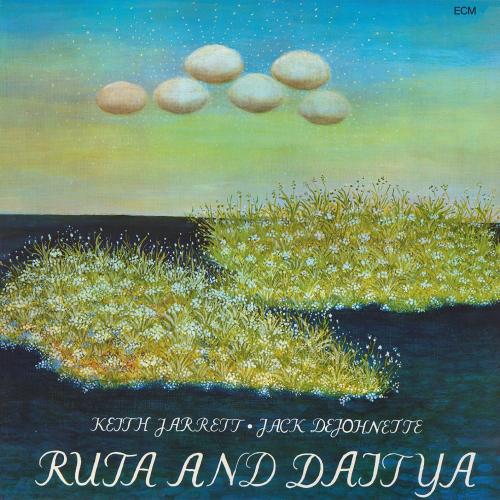
Ruta And Daitya (Remastered) Keith Jarrett, Jack DeJohnette
Album info
Album-Release:
1973
HRA-Release:
30.01.2026
Album including Album cover
I`m sorry!
Dear HIGHRESAUDIO Visitor,
due to territorial constraints and also different releases dates in each country you currently can`t purchase this album. We are updating our release dates twice a week. So, please feel free to check from time-to-time, if the album is available for your country.
We suggest, that you bookmark the album and use our Short List function.
Thank you for your understanding and patience.
Yours sincerely, HIGHRESAUDIO
- 1 Overture - Communion 06:00
- 2 Ruta & Daitya 11:14
- 3 All We Got 02:00
- 4 Sounds Of Peru: Submergence / Awakening 06:31
- 5 Algeria 05:47
- 6 You Know, You Know 07:44
- 7 Pastel Morning 02:04
Info for Ruta And Daitya (Remastered)
Ruta and Daitya is jazz album by pianist Keith Jarrett and drummer Jack DeJohnette, recorded in May 1971 and released on ECM Records in 1973—one of Jarrett's rare performances on electric keyboard.
Keith Jarrett and Jack DeJohnette, who continue their formidable partnership to this day, join forces for an early and unique collaboration. This being the tail end of Jarrett’s electric period with Miles Davis, Ruta and Daitya marks an archivally important transition into his imminent acoustic pilgrimages. “Overture Communion” captures our attention from the start with a funky, wah-wahed electric piano, warmly guiding us into the album’s exciting, yet somehow always plaintive world. The title track shakes things up with a spate of hand percussion as Jarrett flutes a more abstract improvisation than the one that began the album, though to no less captivating effect. When Jarrett abandons flute for piano, a markedly different shape brands itself into the foreground. In doing so, something gets obscured. It’s not that instruments from such seemingly disparate geographies cannot tread the same path, but simply that they don’t speak to each other as complementarily. Thankfully, Jarrett’s return to flute, this time of bamboo variety, puts us right back into the conversation. DeJohnette takes up a standard drum kit for “All We Got,” a cut that runs around in circles, even as it rouses us with its gospel-infused aesthetic. Jarrett finds himself acoustically redrawn in “Sounds of Peru.” Piano and hand drums work magically this time around as the duo hones further the groove it has been searching for. Jarrett opens up his playing, giving DeJohnette a wider berth in which to lose himself. No longer do the drums skirt the periphery, but frolic in the territory proper. There is even what amounts to a percussion solo as Jarrett coos in the background with delight, thus preparing him for an inspired passage that grinds bass notes in counterpoint to his running right hand. In “Algeria,” Jarrett sings into the flute again, leaving me to wonder why we don’t hear him on the instrument more often, though perhaps its linearity is somewhat limiting to a musician with such expansive hands (hence, his propensity for polyphonic playing). “You Know, You Know” brings us full circle to the electric piano for a more laid-back coolness before we end with “Pastel Morning,” a beautiful meditation on the electric piano. In the absence of punchy distortion, it sounds almost like a vibraphone, its gentler capacities allowed to float of their own accord.
The album’s title is a curious one, and offers at best a rather opaque X-ray of the conceptual skeleton it sheathes. Ruta and Daitya refer to two island-continents, remnants of the second cataclysm to befall the great island of Atlantis. Both were populated by races of titans, known as “Lords of the Dark Face” as a means of indicating their ties to black magic. If we are to believe Madame Blavatsky, who in her second volume of The Secret Doctrine outlines their genealogical significance in her mystical, albeit highly racialized, account of creation, the Egyptians inherited the cosmological legacy of the Ruta Atlanteans, as supposedly evidenced in the similarities of their Zodiacal beliefs. Whatever the origins, there is much to ponder in Ruta and Daitya. The sensitive pianism for which Jarrett is so renowned is in full evidence throughout, though for me his flute playing really sells the album. Jarrett proves himself more than adept and plays with an addictive sense of abandon. DeJohnette, meanwhile, enchants with a melodic approach to his kit, especially in his use of cymbals.
Keith Jarrett, piano, electric piano, organ, flute
Jack DeJohnette, drums, percussion
Digitally remastered
Keith Jarrett
At the end of 2008, Keith Jarrett added two concerts to his schedule at short notice – one at Paris’s Salle Pleyel (November 26), one at London’s Royal Festival Hall (December 1) . The music on “Testament” is from these concerts. Their range is compendious, Jarrett’s improvisational imagination continually uncovering new forms, in a music stirred by powerful emotions. In his liner notes, the pianist is forthright about the personal circumstances promoting a need to lose himself in the work once more.
He also reminds the reader/listener that “it is not natural to sit at a piano, bring no material, clear your mind completely of musical ideas and play something that is of lasting value and brand new.” This, however, has been the history and substance of the solo concerts since Jarrett initiated them, almost forty years ago . Over time their connection to ‘jazz’ has often become tenuous, yet Jarrett’s solo concerts, with the foregrounding of melody and the continual building, and relinquishing, of structure, are also removed from “free improvisation” as a genre. Jarrett’s solo work is effectively its own idiom, and has been subject to periodic revisions by the pianist. “In the early part of this decade, I tried to bring the format back: starting from nothing and building a universe.”
Since the “Radiance” album and the “Tokyo Solo” DVD of 2002 Jarrett has been adjusting the flow of the work, more often working with shorter blocks of material. “I continued to find a wealth of music inside this open format, stopping whenever the music told me to.” This approach distinguished “The Carnegie Hall Concert” (2006), and it is most effectively deployed in “Testament” , where the strongly-contrasting elements of the sections of the Paris concert in particular have the logic of a spontaneously-composed suite. The nerves-bared London performance (the first UK solo show in 18 years) is different again: “The concert went on and, though the beginning was a dark, searching, multi-tonal melodic triumph, by the end it somehow became a throbbing, never-to-be-repeated pulsing rock band of a concert (unless it was a church service, in which case, Hallelujah!).”
In the end, the improviser does what must be done. As Keith Jarrett said, a long time ago, “If you’re a rock climber, once you’re halfway up the face of the cliff, you have to keep moving, you have to keep going somewhere. And that’s what I do, I find a way.”
These days, however, Jarrett is rationing the number of ascents: there have been less than thirty solo concerts in the last decade, making “Testament” a special event indeed. Two further solo performances are scheduled for 2009 – at the Palais des Beaux Arts in Brussels on October 9, and at Berlin’s Philharmonie on October 12.
This album contains no booklet.